

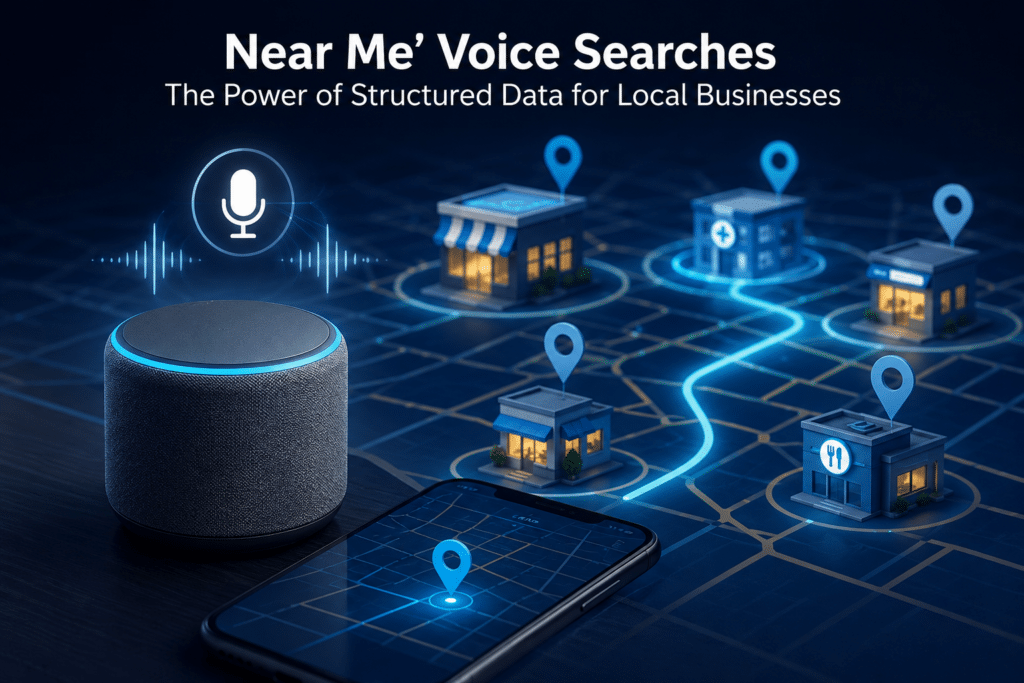
A customer no longer needs to type a complete search query to find a nearby business. They can simply ask, “Where is the nearest dentist?” “Find an Italian restaurant near me,” or “What’s the best garage open now?”
That shift matters because voice queries are naturally conversational, location-aware, and action-oriented. Search systems need to understand not only what a business does, but also where it is, when it is open, how customers can contact it, and which services it provides.
This is where structured data becomes important.
Structured data does not guarantee higher rankings, and Google explicitly states that it is not a generic ranking factor. However, it gives search engines clearer information about the entities and content represented on a page and can make pages eligible for certain enhanced search experiences.
For local businesses, that clarity can become increasingly valuable as search moves toward conversational and assistant-led discovery.
The Rise of Conversational Local Search
Traditional local searches often look like:
“plumber London”
“dentist near me”
“coffee shop open now”
Voice searches tend to sound more like natural conversations:
“Who can fix my boiler nearby?”
“What restaurants are open near me?”
“Find a hairdresser close to me that opens before 9.”
The difference is important.
A typed search may contain only two or three keywords. A spoken query can contain an entire sentence with multiple pieces of information, including location, service, availability, preferences, and urgency.
Search engines therefore have to interpret the meaning behind the query and connect it with businesses that genuinely satisfy the request.
For a local company, simply mentioning a city on a webpage is no longer enough to communicate every important business detail clearly.
Your website needs to make those details understandable to machines as well as humans.
Why ‘Near Me’ Voice Search Changes Local Visibility
The phrase “near me” is not really about the literal words near me. Search engines can use contextual signals such as the searcher’s location, device, query intent, and available business information to determine which local results are relevant.
Imagine someone says:
“Find an emergency plumber near me that is open right now.”
There are several signals hidden inside that one sentence:
- Service: emergency plumbing
- Location: nearby
- Availability: currently open
- Intent: immediate service
- Business type: local service provider
A strong local presence needs to communicate these facts consistently across its website and business listings.
Google’s documentation explains that local-business structured data can communicate information such as business hours, departments, reviews where applicable, and other business details. Google also recommends using the most specific LocalBusiness subtype possible.
This is why near me voice search deserves attention from businesses competing for local customers. The opportunity is not simply about ranking for a phrase. It is about making your business easier for search systems to understand when a customer asks a conversational, location-based question.
Structured Data Is the Missing Layer for Many Local Websites
Many business websites contain the right information, but search engines still have to interpret how that information relates to the business.
A page might display:
ABC Plumbing Ltd.
25 High Street, London
020 XXXX XXXX
Open Monday–Saturday
Emergency plumbing
Boiler repairs
Drain services
A human can understand this immediately.
Structured data gives machines a standardised way to interpret those same details.
Google describes structured data as a standardised format for providing explicit clues about the meaning and classification of page content. JSON-LD is Google’s recommended format, alongside supported alternatives such as Microdata and RDFa.
For a local business, useful structured information can include:
- Business name and type
- Physical address
- Telephone number
- Website URL
- Opening hours
- Geographic information
- Service areas where appropriate
- Departments or specific business locations
- Relevant business relationships
The goal is not to fill a website with unnecessary schema. The goal is to create a reliable machine-readable representation of information already visible to visitors.
That distinction matters because Google’s guidelines require structured data to accurately represent the page content and prohibit misleading or irrelevant markup.
What Happens When Search Engines Cannot Clearly Understand Your Business?
Consider two local companies offering the same service.
Both have attractive websites. Both have good reviews. Both serve the same area.
But one website clearly identifies its business type, address, phone number, opening hours, services, and location information using appropriate structured data. The other contains the information only as ordinary text scattered across several pages.
This does not mean Google will automatically rank the first company above the second.
Structured data is not a shortcut around relevance, authority, proximity, content quality, or other local-search signals. Google specifically says correctly implemented structured data does not guarantee a rich result or special search appearance.
The real advantage is clarity.
When search systems have clearer information about an entity, they have better-defined data to work with when interpreting and connecting that entity to relevant search experiences.
That becomes particularly useful when queries become longer, more conversational, and more specific.
How Local Businesses Can Prepare for Voice-Led Discovery
Optimising for conversational local search starts with the fundamentals.
Your business information should be consistent across your website, Google Business Profile, directories, and other trusted sources. Your address should be accurate. Opening hours should reflect reality. Service pages should clearly explain what you offer and where you offer it.
Then comes the technical layer.
Implement relevant structured data on appropriate pages and make sure the information in the markup matches what users can actually see. Google recommends validating structured data, correcting critical errors, and using tools such as the Rich Results Test and URL Inspection to check how Google processes the page.
For businesses competing in London, professional seo services in London can also help connect technical implementation with broader local-search strategy.
The important point is that structured data should not exist in isolation. It should support a website that already provides useful, accurate, people-first information.
Build Content Around Real Questions, Not Just Keywords
Voice search changes how businesses should think about content.
People rarely speak to an assistant in the same way they type keywords into a search box.
Instead of creating a page that repeatedly uses a phrase such as “emergency plumber London,” consider answering questions customers naturally ask:
“Can you provide emergency plumbing at night?”
“How quickly can you reach customers in my area?”
“Do you repair boilers on weekends?”
“Which areas do you cover?”
This approach makes content more useful because it addresses the actual decision-making process behind a local search.
It also gives search systems more context about the business, its services, locations, and expertise.
For companies that need technical and content support together, London seo services can encompass the broader work of improving local visibility while ensuring website information is structured clearly.
The objective should always be relevance first—not inserting conversational phrases simply because they resemble voice queries.
Local SEO and Structured Data Need to Work Together
Structured data is only one part of local search visibility.
A business can have perfectly implemented markup and still struggle if its website is slow, its content is weak, its location information is inconsistent, or its Google Business Profile is poorly maintained.
Local search works as an ecosystem.
Your website establishes relevance and provides detailed information. Your business profile reinforces your real-world presence. Reviews contribute to reputation. Local references and mentions can strengthen prominence. Technical SEO helps search engines access and understand your pages.
That is why working with a local seo agency uk can be useful when a business needs to connect technical SEO, content, local signals, and business-profile optimisation rather than treating each activity separately.
The strongest strategy is not “add schema and rank.”
It is:
Create a trustworthy local entity → describe it clearly → make its information consistent → provide genuinely useful content → reinforce the same information across the local search ecosystem.
Common Structured Data Mistakes to Avoid
One of the biggest mistakes is treating schema as a place to add information that does not appear on the page.
That can create a mismatch between what search engines are told and what users can actually see. Google’s structured-data guidelines specifically require markup to represent the page content accurately.
Another mistake is using the wrong business type.
A local business should use the most specific applicable LocalBusiness subtype rather than selecting a generic category when a more precise one is available.
Businesses should also avoid:
- Marking up information that is outdated
- Adding fake or misleading reviews
- Creating irrelevant schema simply to qualify for search features
- Copying the same markup blindly across unrelated pages
- Ignoring validation errors
- Treating schema implementation as a substitute for useful content
Google can also change which structured-data features it supports. In 2025, for example, Google announced the retirement of several less-used structured-data search features while noting that the change did not affect rankings.
The lesson is simple: implement structured data for better machine understanding and eligible search experiences—not because every markup type will produce a visible search feature forever.
Make Your Business Easier for Search Assistants to Understand
The future of local discovery is becoming increasingly conversational.
Customers can ask questions instead of constructing keyword-perfect searches. They can describe a need, add a location, mention a preference, and expect an assistant to identify an appropriate business.
That puts pressure on local companies to communicate their identity and services clearly across every important digital touchpoint.
For businesses investing in seo consultants london, the conversation should therefore go beyond traditional rankings. Technical structure, entity clarity, local relevance, content quality, business information, and conversational intent all deserve attention.
The same principle applies when investing in local seo optimization services: the objective should be to make the business genuinely easier to discover, understand, evaluate, and contact.
Near me voice search is not simply another keyword trend. It represents a broader change in how people express local intent.
Businesses that make their information accurate, accessible, useful, and machine-readable will be better prepared for that shift.
Structured data alone will not guarantee visibility. But when it is implemented correctly as part of a comprehensive local SEO strategy, it can give search engines clearer signals about who you are, what you offer, where you operate, and when customers can reach you.
And when a customer asks an assistant for a nearby business, that clarity can matter.