


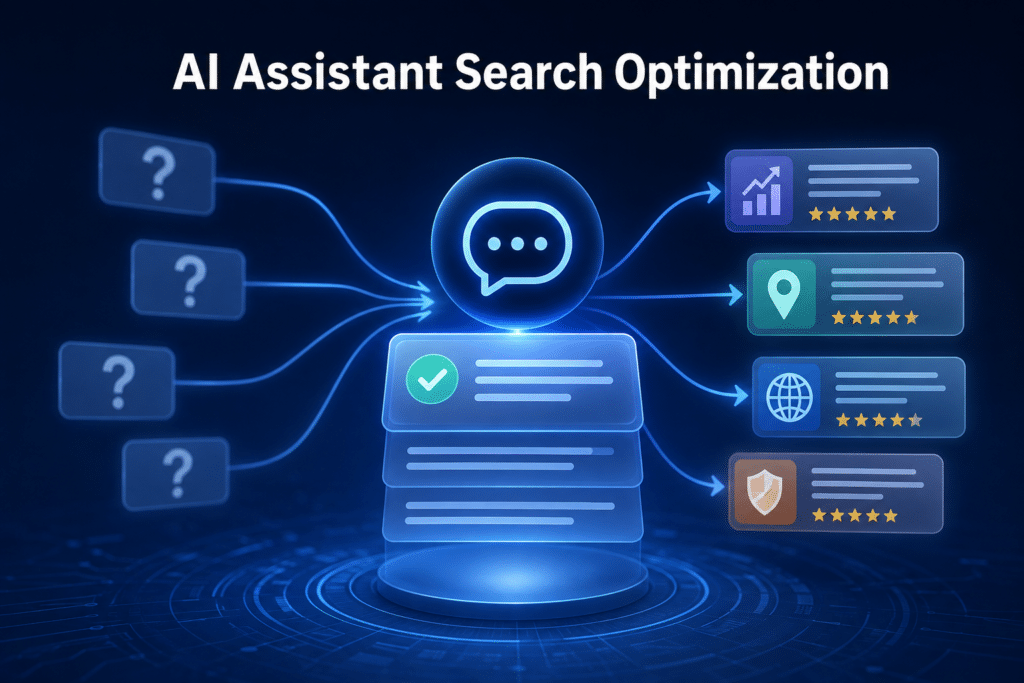
A customer no longer needs to visit five websites, compare services, or browse through multiple search results to make a decision. Increasingly, they can ask an AI assistant a simple question and receive a direct, conversational answer.
“Who offers the best service near me?”
“Which company should I choose?”
“What should I look for before hiring an agency?”
“Is this business trustworthy?”
These questions may never produce a traditional website click. Yet they can strongly influence which business the customer considers next.
That creates a new challenge for brands: being visible in search is no longer only about ranking a webpage. It is also about becoming a reliable source that AI systems can understand, trust, and reference.
This is where AI assistant search optimization becomes important. It focuses on making a business’s information clear, useful, credible, and discoverable across the growing ecosystem of AI-powered search and answer experiences.
Search Is Becoming a Conversation
Traditional search generally starts with a keyword. A person enters a phrase into a search engine, receives a list of results, evaluates those results, and decides which website to visit.
AI-assisted search changes that journey.
Instead of searching for “best accountant Birmingham,” a customer might ask an AI assistant:
“Which accountants in Birmingham specialize in small businesses, and what should I compare before choosing one?”
The question contains context, preferences, and expectations. The user is not simply looking for a page containing matching words. They want an answer.
AI systems therefore need to interpret several signals at once, including the meaning of the query, the user’s likely intent, business information, topical relevance, credibility, location, and information available across trusted sources.
This means businesses need to think beyond individual keywords.
The goal is to provide information that answers the questions customers actually ask before, during, and after a purchase decision.
Why Competitors Can Win the Answer
Imagine two businesses offer similar services.
Business A has a website with short service descriptions, generic marketing claims, and limited information about its expertise.
Business B explains its services clearly, answers common customer questions, demonstrates experience, publishes useful resources, maintains accurate business information, and earns relevant mentions from credible sources.
When an AI assistant needs to formulate an answer, Business B gives the system considerably more useful information to work with.
This does not mean an AI assistant will automatically recommend Business B. AI-generated answers are influenced by numerous systems, sources, algorithms, and contextual factors.
However, it demonstrates an important principle: businesses that consistently publish useful, understandable, trustworthy information give search systems more evidence about who they are and what they know.
Your competitor does not necessarily need to outrank you for every traditional search term to influence your potential customer.
They may simply provide the better answer.
Building a Strategy Around AI Questions
Effective AI assistant search optimization starts with understanding customer questions rather than beginning with a list of keywords.
Think about the complete decision journey.
Before purchasing, customers may ask questions about pricing, quality, suitability, alternatives, location, experience, risks, timelines, and expected outcomes. During the decision process, they may compare providers or ask how a particular service works.
After choosing a provider, they may search for instructions, maintenance information, troubleshooting guidance, or ways to get better results.
Each question represents an opportunity to demonstrate expertise.
For example, a professional service business could create resources explaining:
- What the service includes
- Who the service is suitable for
- How the process works
- How long the process typically takes
- What factors affect pricing
- What customers should ask before hiring a provider
- Common mistakes customers should avoid
- How different solutions compare
The purpose is not to create hundreds of shallow pages.
It is to build a useful information ecosystem around the problems your business genuinely understands.
Local Relevance Still Matters
AI search does not eliminate the importance of local information. In many cases, location is an essential part of the customer’s question.
Someone asking for “a reliable marketing agency” has a very different intent from someone asking for “a reliable marketing agency in Birmingham.”
Location can affect recommendations because customers often want businesses that serve a particular area, understand the local market, or have a physical presence nearby.
For businesses targeting Birmingham, seo services Birmingham should not be treated simply as a phrase to insert repeatedly into pages. Local relevance should be supported by accurate business information, location-specific service details, useful local content, consistent business references, and genuine customer experiences.
Likewise, a seo company birmingham can strengthen its digital presence by clearly explaining its expertise, service areas, processes, case studies, and answers to questions prospects commonly ask.
The same principle applies at a broader UK level. A local seo agency uk should demonstrate genuine knowledge of local search behavior rather than relying on generic claims about rankings.
The important distinction is between mentioning a location and demonstrating relevance to that location.
Make Your Business Easy for AI to Understand
AI systems need to interpret information before they can use it.
A website that is visually attractive but vague about its services creates unnecessary ambiguity.
Your website should make fundamental business information obvious.
Clearly explain what your company does, who it serves, where it operates, what makes its approach different, and which problems it solves.
Service pages should answer meaningful questions rather than simply repeat promotional statements.
For example, instead of writing:
“We provide high-quality professional solutions.”
Explain what the solution involves, when customers need it, what the process looks like, what factors influence the result, and how customers can determine whether the service is right for them.
Specific information creates context.
Structured content can also help search systems understand relationships between your business, services, locations, people, organizations, and other relevant entities. Accurate headings, descriptive page titles, internal links, structured data where appropriate, and consistent terminology can all contribute to clearer interpretation.
The objective is not to “write for an AI.”
The objective is to make your information exceptionally clear for humans and machines alike.
Build Evidence, Not Just Claims
One of the biggest differences between weak and strong online content is evidence.
A company can say it is experienced, reliable, knowledgeable, or customer-focused. Those claims become more meaningful when the website provides evidence supporting them.
Consider case studies.
Instead of saying that your company delivers excellent results, explain the original challenge, the approach taken, the relevant decisions, and the measurable or observable outcome.
Customer reviews can provide another layer of evidence, particularly when they describe specific experiences rather than offering only generic praise.
Expert authorship, transparent business information, original research, demonstrations, detailed guides, and credible third-party references can also contribute to a stronger overall reputation.
This matters because AI-driven search experiences need to determine which information is useful and trustworthy enough to incorporate into an answer.
A business that consistently demonstrates expertise gives customers—and search systems—more substance to evaluate.
Don’t Ignore Traditional SEO
AI search does not make traditional SEO irrelevant.
Search engines still need to discover, crawl, understand, and evaluate web content. Strong technical foundations, useful pages, internal linking, relevant content, mobile usability, site performance, and appropriate structured data remain important parts of a healthy search presence.
The difference is that businesses now need to consider a broader search journey.
Local seo optimization services can help businesses build stronger location-based visibility, but the underlying strategy should extend beyond map rankings and conventional local queries.
For example, consider what happens after someone discovers a business.
They may search its name, ask an AI assistant whether the company is reputable, compare it with competitors, look for reviews, investigate its expertise, or ask whether its services are appropriate for their specific situation.
A strong digital presence should support every stage of that journey.
SEO should therefore be viewed less as a ranking exercise and more as an information and trust strategy.
Create Content Around Real Customer Intent
The most valuable content ideas often come directly from customers.
Sales teams hear objections.
Customer service teams hear recurring problems.
Business owners hear questions during consultations.
Reviews reveal expectations and frustrations.
These conversations can become a powerful content roadmap.
Suppose customers repeatedly ask whether a particular service is worth the investment. Instead of answering the same question privately every time, create a detailed resource explaining when the service makes sense, what factors determine its value, what alternatives exist, and what customers should consider before purchasing.
If people frequently compare two solutions, publish a balanced comparison.
If customers misunderstand a technical process, create an easy-to-understand explanation.
This approach produces content with genuine usefulness because it originates from real information needs rather than an arbitrary publishing calendar.
It also gives your brand more opportunities to demonstrate expertise across different stages of the decision process.
Measure Visibility Beyond Website Clicks
Website traffic remains important, but it should not be the only metric used to evaluate search performance.
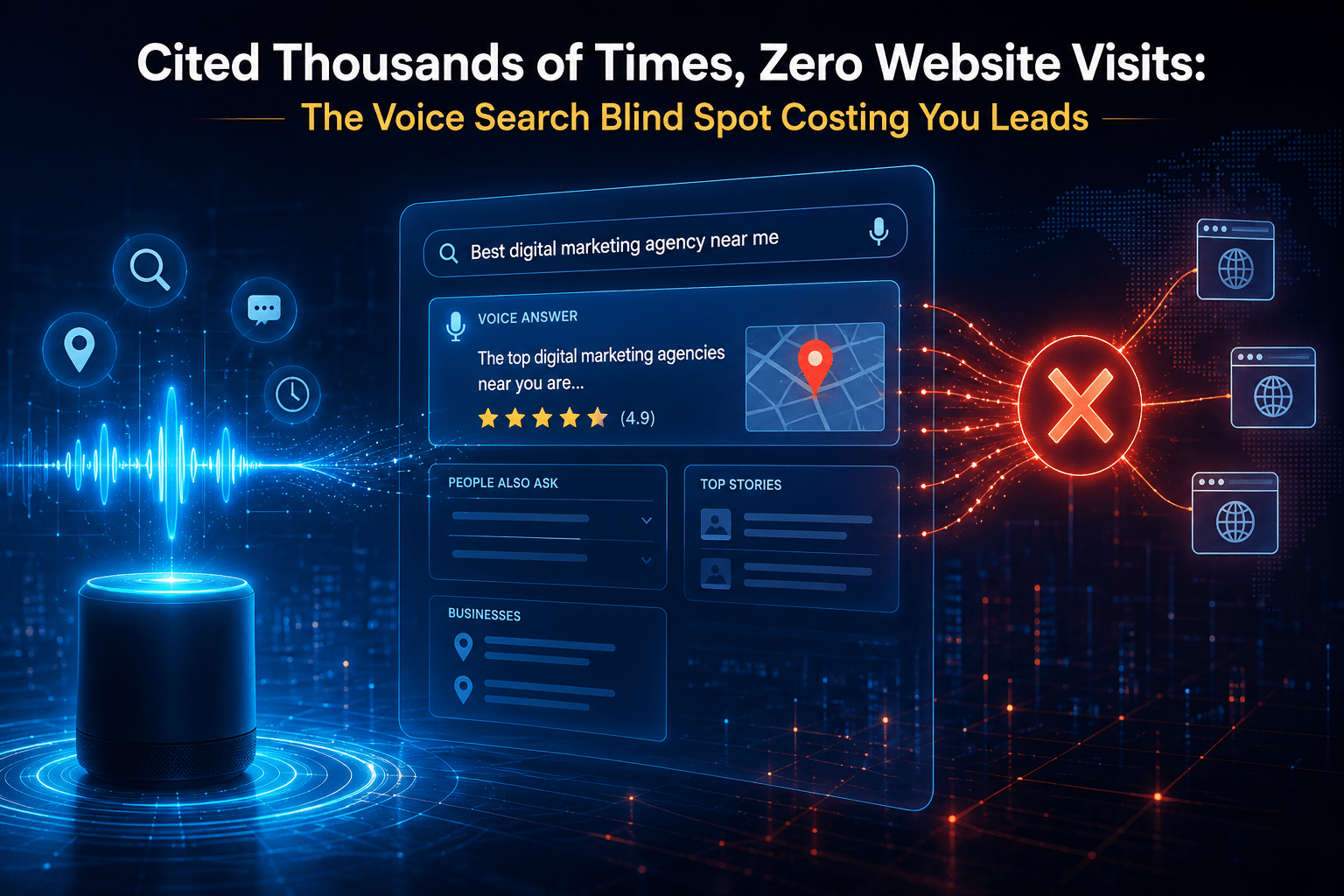
AI-generated answers can influence customers before they ever visit your website.
A prospect may see your business mentioned in an AI answer, remember your brand, and later search directly for it. Another customer may encounter your expertise while researching a problem and return to your website days later.
This makes attribution more complicated.
Businesses should monitor branded searches, referral patterns, local visibility, conversions, engagement with informational content, customer questions, and changes in how their brand appears across search experiences where measurement is available.
The question is no longer simply:
“How many clicks did we receive?”
It is increasingly:
“Did our business become part of the customer’s research process?”
That is a much broader definition of search visibility.
Where Birmingham Businesses Should Focus
For businesses competing in Birmingham, visibility increasingly depends on being useful at the exact moments customers research, compare, and validate potential providers.
Birmingham seo services can support the traditional foundations of local search visibility, but businesses should also develop content that answers detailed customer questions and establishes topical authority.
This could include location-specific guides, service comparisons, frequently asked questions, customer education resources, practical checklists, case studies, and expert explanations.
The strongest local strategy connects these resources together.
A service page explains the offering.
An educational article answers a related customer question.
A case study demonstrates practical experience.
Reviews provide customer evidence.
Business information confirms location and service details.
Internal links connect these pieces into a coherent topic.
Together, they create a much stronger picture of the business than a collection of isolated keyword-focused pages.
The Competitive Advantage Is Becoming the Best Answer
AI-powered search is changing how customers discover information, but the underlying principle is surprisingly simple: people want useful answers from sources they can trust.
Businesses that focus exclusively on rankings may miss this shift.
Businesses that understand customer questions can respond differently.
They can build detailed resources, explain complicated subjects clearly, demonstrate real experience, maintain accurate business information, earn credible recognition, and create content that genuinely helps people make decisions.
That is the foundation of AI assistant search optimization.
Your competitor may already be answering the questions your customers are asking.
The opportunity is not to produce more content simply for the sake of visibility. It is to make your business the clearest, most useful, and most credible source for the questions that matter to your customers.
When your expertise is easy to discover, understand, verify, and trust, your brand has a better chance of becoming part of the conversation—whether that conversation happens on a traditional search engine, an AI assistant, or the next generation of search experiences.