

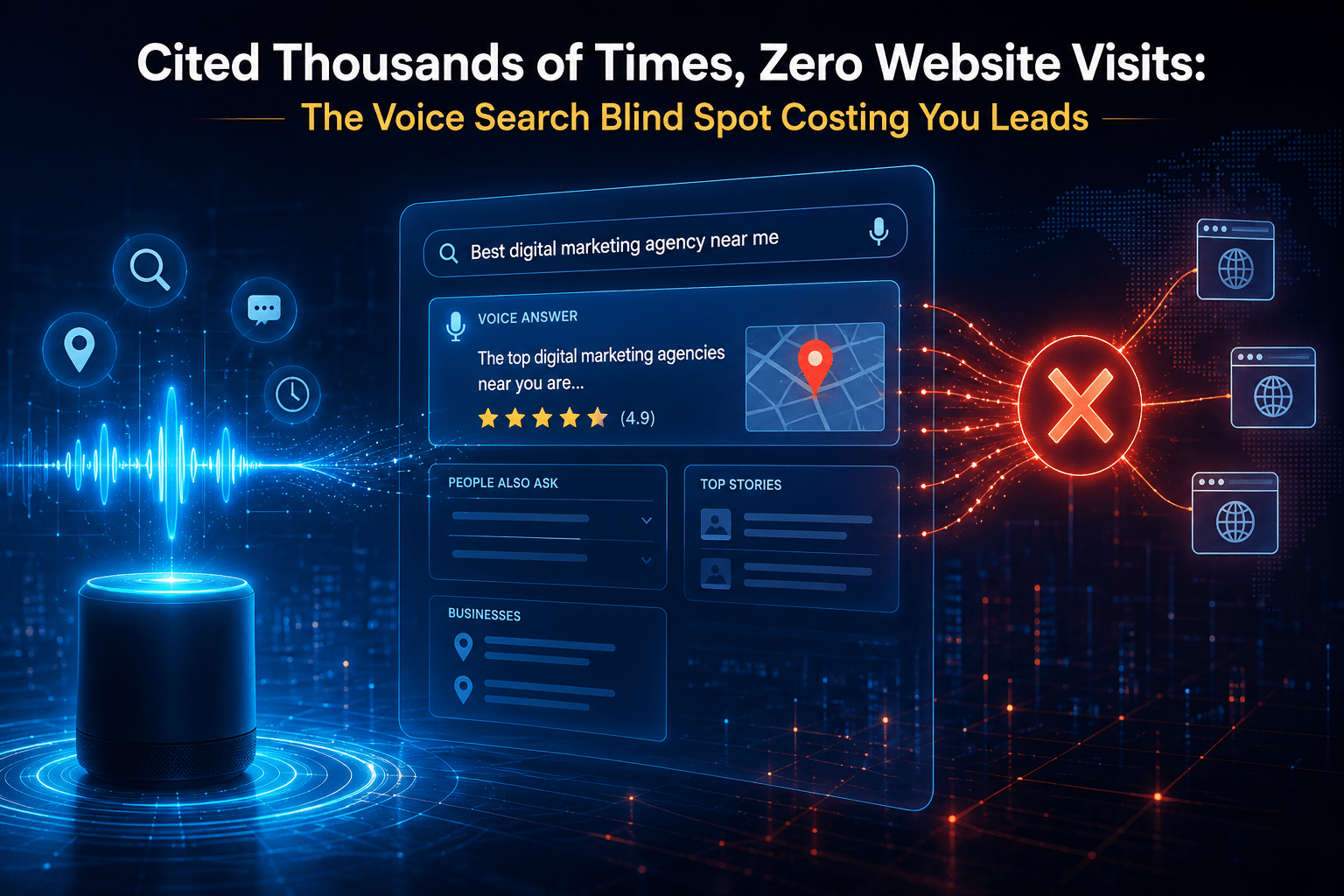

A business can be mentioned repeatedly in voice and AI-powered search results without receiving a single website visit. That sounds contradictory, but it is becoming a common reality as search moves from traditional blue links toward spoken answers, summaries, and conversational results.
The problem is not necessarily that your website lacks authority. Your brand may already be appearing in answers generated from search engines, digital assistants, and AI systems. The bigger issue is that voice search visibility is often measured incorrectly. Businesses focus on rankings and clicks while overlooking whether their information is being selected, understood, and presented when customers ask questions through voice.
For companies that depend on local customers and high-intent searches, this distinction matters. A business can influence a customer’s decision without receiving the traditional website traffic that marketers have always used to measure success.
The Hidden Shift From Clicks to Answers
Traditional search creates a relatively simple journey: someone enters a query, reviews several results, clicks a website, and explores its content.
Voice search changes that journey.
Instead of presenting ten blue links, a voice assistant may provide one direct answer. A user might ask, “Which plumber is open near me?” or “What is the best SEO agency in London for a small business?” The system may interpret the query, evaluate available information, and provide a concise response.
The customer may never see the website that supplied some of the information.
This creates an important measurement problem. Website analytics can show little or no traffic even when a brand is being surfaced during conversational searches. If marketers judge performance exclusively through sessions and clicks, they may conclude that voice search is delivering nothing.
In reality, the interaction may have happened before the user ever reached a webpage.
Why Voice Search Can Generate Visibility Without Traffic
Voice search is fundamentally different from a conventional search result because the user is often looking for a quick resolution rather than a list of websites.
Consider a person asking:
- “What time does the dentist close today?”
- “Who provides emergency electrical services near me?”
- “How much does a boiler repair usually cost?”
- “Which restaurant nearby is open right now?”
A useful answer can satisfy the immediate need.
The customer might then call the business, visit its physical location, save its name, or search for the brand directly later. None of those actions necessarily appear as a direct organic website visit from the original voice query.
This is why voice search visibility should not be treated as a simple traffic-generation channel. It is also an opportunity to influence decisions at the exact moment someone is looking for information.
The challenge is ensuring that search systems can confidently understand your business, content, services, location, expertise, and relevance.
The London Search Problem: Being Relevant Is Not Enough
For businesses competing in major cities, search visibility becomes even more complicated because users often combine services with highly specific local intent.
Someone might search for “SEO agency near me,” “SEO consultant in London,” or ask a voice assistant to recommend an agency for a particular type of business. Search engines need to determine which businesses are genuinely relevant to the query rather than simply matching keywords on a page.
This is where London businesses need to think beyond traditional rankings.
A website may rank well for a few important terms but still provide weak signals for conversational searches. SEO services London and SEO in London can represent different search intents depending on the context, while voice queries are often longer and more conversational.
For example, a typed search might be:
“SEO agency London”
A spoken query could be:
“Can you recommend an SEO company in London that works with small businesses?”
The second query contains considerably more context. A business needs content and structured information that help search systems understand not only where it operates, but also what it does, who it serves, and why it is relevant.
What Actually Determines Voice Search Visibility?
There is no single ranking factor that guarantees a business will be selected for a voice answer. Instead, multiple signals can contribute to how confidently a search system understands and evaluates a business.
Clear, Direct Information
Voice assistants need answers they can interpret quickly. Pages containing vague introductions, excessive marketing language, or buried answers can make extraction more difficult.
Important information should be stated clearly. Service descriptions, operating information, locations, contact details, pricing explanations, policies, and frequently asked questions should be easy to identify.
Conversational Content
People rarely speak exactly as they type.
Written content should therefore address natural questions instead of relying exclusively on short keyword phrases. A useful article might answer “How long does local SEO take?” rather than simply repeating a phrase such as “local SEO timeline.”
The goal is not to create artificial voice-search content. It is to make existing content genuinely useful for the way people ask questions.
Strong Local Signals
For local businesses, location information is particularly important. Consistent business details, relevant local pages, accurate profiles, reviews, and geographically useful content can help search systems establish where a company operates.
Authority and Trust
Search systems need reasons to trust the information they present. Original expertise, accurate claims, credible references, strong reputation signals, useful content, and a consistent business presence all contribute to a more trustworthy digital footprint.
Why Traditional SEO Metrics Miss the Real Picture
Organic traffic remains valuable, but it does not tell the entire story.
Imagine that a customer asks a voice assistant a question about a service. The assistant provides your company’s name and a short answer based partly on information associated with your website. The customer remembers the business and calls directly.
Your analytics may record a phone lead, but they may not reveal that voice search influenced the decision.
This is why businesses should consider a broader measurement framework.
Instead of asking only, “How many visitors came from organic search?” consider:
- Are important questions about the business being answered accurately?
- Is the business appearing for conversational local queries?
- Are branded searches increasing?
- Are phone calls or enquiries increasing?
- Is the company being associated with the right services and locations?
- Are search impressions growing even when clicks remain relatively stable?
- Is useful business information consistent across major platforms?
These questions provide a more realistic view of search influence.
How to Build Better Voice Search Visibility
Improving voice search visibility starts with making your website easier for both users and search systems to understand.
Start by identifying the questions customers actually ask before contacting your business. These questions can come from sales conversations, customer support messages, reviews, Google search suggestions, FAQs, and conversations with your team.
Then create genuinely useful answers.
Do not write an answer simply because you want to rank for a keyword. Write it because a potential customer needs the information.
For example, instead of creating a generic page about “emergency plumbing,” answer practical questions such as:
“What counts as a plumbing emergency?”
“How quickly can an emergency plumber arrive?”
“How much does emergency plumbing usually cost?”
“What should I do before the plumber arrives?”
This approach gives search systems clear information to interpret while giving customers a reason to trust the business.
Technical accessibility also matters. A website should be crawlable, mobile-friendly, fast enough to use comfortably, and logically structured. Heading hierarchy, internal links, descriptive page titles, structured data where appropriate, and consistent business information can all contribute to better understanding.
Where Local SEO Fits Into Voice Search
Voice queries frequently contain strong local intent. Phrases such as “near me,” “open now,” “best around here,” and “in my area” indicate that the searcher is looking for a nearby solution.
That makes local optimization an important part of preparing for conversational search.
Businesses should maintain accurate business information across relevant platforms and ensure that their website clearly communicates its service areas. Location pages should offer genuine local value rather than simply replacing the city name across duplicated templates.
For businesses serving the UK market, local SEO services UK can be particularly relevant when the goal is to establish stronger geographic signals across multiple locations.
Likewise, businesses evaluating SEO services in London should consider whether the provider understands conversational and local search rather than focusing solely on conventional keyword rankings.
For smaller companies, local SEO services for small businesses can help address the practical challenge of competing with larger brands for geographically specific searches.
The Biggest Mistake: Optimizing for Voice as a Separate Channel
One of the biggest misconceptions is that businesses need an entirely separate “voice SEO” strategy.
In most cases, the stronger approach is to improve the underlying quality and clarity of the information already being published.
Voice search, traditional search, local search, and AI-powered search increasingly depend on overlapping signals: relevance, context, useful content, business information, authority, and trust.
Instead of creating pages filled with awkward spoken-language keywords, businesses should build a website that answers real customer questions clearly.
That means improving existing pages, strengthening local information, creating useful FAQs, demonstrating expertise, maintaining accurate business details, and ensuring that important information is easy to interpret.
How to Know If Your Strategy Is Working
Measuring success requires more than checking whether voice traffic appears inside analytics.
Look for changes across multiple areas. Search impressions can reveal increased visibility even when clicks remain flat. Branded searches can indicate stronger awareness. Calls, direction requests, enquiries, and offline conversions can show whether visibility is influencing real-world behaviour.
It is also useful to monitor the questions that matter most to the business. If your company provides several services, identify the highest-value customer questions for each one and regularly check how search engines and conversational systems represent the information.
Most importantly, compare search visibility with business outcomes.
The purpose of optimization is not simply to be mentioned. It is to become a credible option when a potential customer is ready to act.
The Future of Search Is Not Always a Click
The assumption that every successful search interaction must end with a website visit is becoming outdated.
A customer can discover a business through a spoken question, receive an answer, remember the brand, and make contact later. In that journey, the website may influence the result without appearing in the final analytics report as a traditional organic session.
That is the voice search visibility blind spot.
Businesses that understand this shift can build content around real questions, strengthen their local signals, provide clearer information, and measure search performance beyond clicks alone. The goal is not simply to appear somewhere in a search result. It is to provide information strong enough that search systems can confidently use it when customers ask for answers.
When search becomes conversational, being useful is part of being visible.