


When people search online, they are no longer relying only on traditional search results. Increasingly, they are asking AI-powered systems direct questions and expecting a clear, useful answer within seconds. Instead of choosing from ten blue links, users may ask an AI assistant which company to hire, which product is worth buying, or which service provider is most reliable.
That creates a new challenge for businesses: being visible is no longer enough. Your brand must also be considered credible enough for an AI system to recommend it.
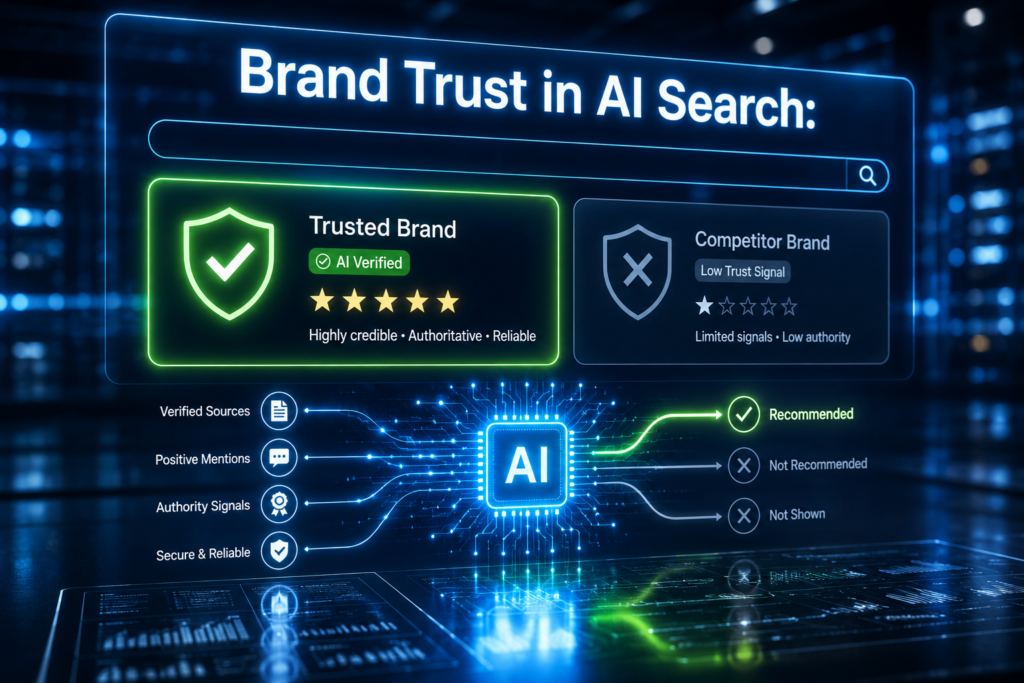
This is where brand trust in AI search becomes a critical part of modern digital visibility. AI systems assess information from many sources before generating answers. If your company has inconsistent information, weak authority, limited third-party recognition, poor reviews, or unclear expertise, another brand may appear more trustworthy—even if your business is actually the better choice.
The result is simple: when AI chooses your competitor as the answer, you can lose attention, traffic, leads, and customers before they ever visit your website.
Why AI Trust Is Becoming a Business Advantage
Traditional search visibility has largely revolved around rankings. Businesses focused on keywords, technical optimization, backlinks, content quality, and user experience to improve their position in search results.
AI-driven search changes the nature of that competition.
An AI-generated answer may combine information from websites, business profiles, reviews, publications, directories, expert discussions, and other publicly available sources. The system is not simply asking, “Which website contains this keyword?” It is attempting to determine which information is relevant, reliable, and useful enough to support an answer.
That means your brand reputation becomes part of your search strategy.
Imagine two companies offering similar services. Company A has a polished website but very little independent information about it. Company B has detailed service pages, consistent business information, strong customer feedback, expert mentions, useful educational content, and references from respected websites.
When an AI system needs to recommend one, Company B gives it considerably more evidence to work with.
This is the fundamental shift: search visibility is moving from simply being discoverable to being defensible.
What Does Brand Trust in AI Search Actually Mean?
Brand trust in AI search refers to the level of confidence an AI-powered search system can develop from the available evidence surrounding a brand.
It does not mean that an AI system has human emotions or personally “trusts” a company. Instead, trust is reflected through the signals and information that help a system determine whether a brand is credible, relevant, established, and appropriate to mention.
Several factors can contribute to this perception.
First is consistency. Your business name, services, location, expertise, and other important details should make sense wherever your brand appears online. Contradictory information can weaken the reliability of your digital footprint.
Second is independent validation. A company talking positively about itself is expected. Independent websites, customers, publications, industry organizations, and knowledgeable professionals provide stronger evidence because they are not simply repeating the brand’s own claims.
Third is demonstrated expertise. Generic marketing statements rarely establish authority. Detailed explanations, original research, practical guidance, case studies, expert commentary, and genuinely useful resources provide much stronger signals.
Finally, there is reputation. Reviews, mentions, discussions, citations, and customer experiences can influence how confidently your business can be presented in an AI-generated recommendation.
The objective is therefore not to manipulate an AI into mentioning your business. It is to build a digital presence that gives the system legitimate reasons to mention you.
How SEO Services Need to Evolve for AI Discovery
Businesses investing in SEO Services should increasingly think beyond rankings and individual keywords.
The traditional approach often treats a website as the central source of authority. But AI search can draw from an entire ecosystem of information. Your website is important, but it is only one part of the evidence available about your organization.
A stronger strategy begins by identifying what your brand should be known for. Then, every major digital asset should reinforce that expertise naturally.
Your website should clearly explain what you do, who you serve, how your solutions work, and why customers should believe your claims. Author information, company details, original insights, transparent policies, and supporting evidence can make the content more useful and credible.
The next step is building consistency across external platforms. Business directories, professional profiles, industry publications, review platforms, partner websites, and relevant communities should not present conflicting versions of your company.
This is especially important for businesses operating across multiple markets. A brand that appears established and consistent across its digital footprint creates a much stronger foundation than one that has excellent content but fragmented information elsewhere.
AI Search Rewards Evidence, Not Empty Claims
One of the biggest mistakes businesses can make is publishing large volumes of content that says essentially the same thing.
AI systems need information that helps answer questions. A page saying that a company is “the best,” “leading,” or “trusted” provides little useful evidence without supporting context.
Strong content demonstrates expertise rather than simply declaring it.
For example, instead of writing a generic article about why a particular service is important, a business could explain how the service works, what mistakes customers commonly make, how costs are determined, what results can realistically be expected, and when the service may not be appropriate.
That type of content answers real questions.
Original research can be even more valuable. Surveys, industry data, comparisons, customer trends, practical experiments, and documented case studies give other websites something worth referencing. Once independent sources begin citing those insights, your brand can develop a stronger network of credibility.
This creates a positive cycle:
Useful information creates recognition. Recognition creates references. References strengthen authority. Authority increases the likelihood of being considered when an AI system constructs an answer.
That is why AI SEO should not be treated simply as another keyword optimization technique. It is fundamentally connected to information quality, entity clarity, reputation, authority, and the usefulness of your overall digital presence.
Why Your Competitor Can Win Even When You Have Better Products
A superior product does not automatically produce superior search visibility.
Your business may provide better service, employ more experienced professionals, or offer a stronger solution. But if those advantages are difficult to verify online, an AI system may not have enough evidence to confidently include them in its answer.
Meanwhile, your competitor may have hundreds of reviews, expert interviews, detailed educational resources, industry mentions, strong profiles, and years of consistent online information.
From the AI system’s perspective, that competitor may simply be easier to understand and substantiate.
This is why companies should think about answer eligibility, not just ranking positions.
Ask questions such as:
- Can an AI system clearly understand what our company does?
- Is our expertise supported by evidence outside our own website?
- Are our business details consistent across important platforms?
- Do independent sources mention or reference our brand?
- Does our content answer the questions customers actually ask?
- Are our claims supported by specific examples, data, or experience?
If the answers are weak, improving visibility alone may not solve the problem.
Local Reputation Matters More Than Many Brands Realize
For businesses that depend on customers in specific locations, Local SEO is closely connected to trust.
A customer looking for a nearby professional does not simply need to know that a company exists. They want confidence that the business is legitimate, relevant to their area, experienced, and worth contacting.
Accurate business information, genuine reviews, location-specific content, consistent profiles, local references, and community recognition can all contribute to that confidence.
The same principle applies to AI-generated local recommendations. If a system is asked to suggest a business in a particular area, brands with clear geographic relevance and strong supporting information have a better foundation for being considered.
Local authority should therefore be built deliberately rather than treating location information as a minor website detail.
Building a Brand AI Can Confidently Recommend
There is no single tactic that guarantees inclusion in every AI-generated answer. Instead, businesses should build a broad and consistent credibility framework.
Start with your website. Make your services, expertise, team, experience, and unique strengths easy to understand. Remove vague claims and replace them with evidence.
Then examine your wider digital footprint. Look for outdated company information, inconsistent descriptions, missing profiles, weak review coverage, and opportunities for credible third-party mentions.
Content should also become more useful. Build resources around genuine customer questions instead of producing articles purely to insert keywords. A strong content library should explain complex subjects clearly, address objections, compare options fairly, and demonstrate practical expertise.
Reviews deserve special attention as well. Encourage genuine customers to share detailed experiences without attempting to manufacture positive feedback. Authentic reputation is much more sustainable than artificial reputation.
Finally, monitor how your brand is represented online. Search for your company name, services, products, executives, and key topics. Look for gaps between what your business claims and what independent sources say about it.
The United Kingdom Example: Why Digital Credibility Matters
For businesses competing in the United Kingdom, digital trust can become particularly important when customers compare multiple established providers.
A potential customer may ask an AI system to recommend an agency, consultant, retailer, professional service, or local provider. If several companies appear relevant, the deciding factor may not be who has the most aggressive marketing.
It may be which business has the clearest and most credible body of information surrounding it.
That means companies should treat reputation, expertise, customer experience, and online consistency as long-term search assets. A strong brand does not simply tell people that it deserves attention. It continually creates evidence that makes the claim believable.
The Future of Search Belongs to Brands That Can Be Verified
The biggest lesson is that AI-powered search is making brand credibility increasingly measurable through the information available online.
Brand trust in AI search is not something a company can manufacture with a single campaign or technical adjustment. It develops through consistent information, genuine expertise, independent recognition, useful content, customer experiences, and a reputation that can withstand scrutiny.
Your competitor does not necessarily need to be better than you to win the answer. They may simply be easier for an AI system to understand, verify, and recommend.
That is the opportunity for forward-thinking businesses.
Instead of asking only, “How do we rank higher?” start asking, “Why would an AI system confidently recommend us?”
When your digital presence provides a strong answer to that question, your brand becomes more than a search result. It becomes a credible source that can earn visibility when customers are actively looking for an answer.
And in an environment where the answer itself increasingly determines which businesses get considered, brand trust in AI search can become one of the most valuable competitive advantages your company builds.