


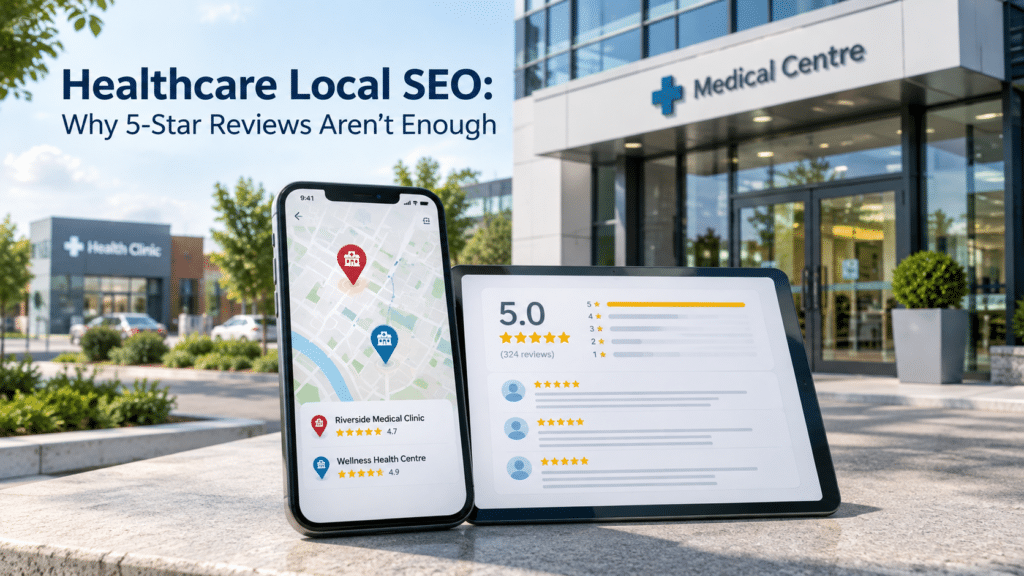
Your clinic has hundreds of five-star reviews. Patients consistently praise your doctors, staff, facilities, and level of care. Yet when someone searches Google Maps for a nearby healthcare provider, your competitor appears above you.
It feels frustrating because reviews are one of the most visible signs of trust. If your clinic has a higher rating and more positive feedback, why isn’t Google putting you first?
The answer is that Google Maps does not operate like a simple review leaderboard.
A strong review profile can influence patient decisions, but local visibility depends on several other factors, including relevance, distance, prominence, website signals, business information, search intent, and the overall consistency of your online presence.
This is why a clinic can have an excellent reputation and still lose valuable local searches to a competitor with fewer reviews.
Google Maps Looks Beyond Your Star Rating
When Google decides which healthcare businesses to show for a local search, it is trying to determine which results are most useful for that specific person and query.
Reviews are one piece of that decision.
Suppose two clinics are competing for visibility. Clinic A has 700 reviews with a 4.9-star rating. Clinic B has 250 reviews with a 4.7-star rating.
At first glance, Clinic A appears to have the obvious advantage.
But what if Clinic B has a website with detailed pages about the exact treatment being searched for? What if its Google Business Profile accurately reflects that specialty? What if its location is more relevant to the searcher’s position? What if reputable local and healthcare websites consistently mention Clinic B?
Google has more information to evaluate than the review count.
The important lesson is that more reviews do not automatically mean a higher Maps position.
Reviews can strengthen trust, but Google still needs to understand whether your clinic is the right answer for the search.
The Three Signals Behind Local Visibility
Google’s local results are generally influenced by three broad concepts: relevance, distance, and prominence.
Relevance concerns how closely a business matches what someone is searching for.
If a patient searches for a specific medical treatment, Google needs evidence that your clinic genuinely provides that service. A generic description such as “professional healthcare clinic” may not communicate enough detail.
Distance refers to how close the business is to the searcher’s location or the location included in the search.
This is particularly important for searches containing phrases such as “near me” or a specific town or neighbourhood. A clinic cannot completely control this factor because the searcher’s location changes.
Prominence relates to how established and recognized the business appears online and offline.
This can involve factors such as website authority, mentions from reputable sources, links, brand recognition, reviews, and other signals that help Google understand the business.
These three concepts explain why a clinic with an outstanding rating can still be outranked.
The strongest local presence usually comes from multiple signals working together rather than one impressive metric.
Why Healthcare Local SEO Requires More Than Reviews
Healthcare local SEO focuses on helping search engines understand a healthcare practice in its specific geographic and service context.
That means Google should be able to determine what your clinic does, which services it offers, where it operates, and why it is relevant to particular patient searches.
Consider a clinic that provides several services but has only one broad website page describing them all.
A competitor may have dedicated, genuinely useful pages explaining each major service, including who the service is for, what patients can expect, relevant qualifications, frequently asked questions, and how to arrange an appointment.
Even if your clinic has a stronger review profile, the competitor’s website may provide clearer topical evidence.
The same principle applies to the Google Business Profile. Your primary category, services, description, contact details, opening hours, appointment information, and other profile elements should accurately represent the business.
The objective isn’t to add information simply for the sake of optimization. It is to remove ambiguity.
When your website and business profile clearly communicate the same information, Google has a stronger foundation for connecting your clinic with relevant local searches.
Your Competitor May Have Better Search Relevance
One of the easiest mistakes to make is assuming that Google ranks clinics according to overall quality.
Google cannot directly measure every aspect of patient care.
Instead, it uses available signals to estimate which business is most relevant to a particular query.
This creates an important distinction.
Your clinic may genuinely provide better patient care, have more experienced professionals, and receive more positive reviews. But if your competitor’s online presence communicates its relevance more clearly, Google may still give that competitor greater visibility.
For example, imagine someone searches for a particular specialist.
Your clinic’s homepage might mention the specialist once.
Your competitor might have a dedicated specialist page, practitioner profile, supporting educational content, relevant internal links, structured business information, and consistent references elsewhere online.
That does not automatically make the competitor a better healthcare provider.
It simply gives search engines more contextual information.
For UK businesses, this can become particularly important in competitive cities and densely populated areas where several clinics may serve similar patient groups.
Your Google Business Profile Could Be Holding You Back
A Google Business Profile can look complete while still having weaknesses that affect local visibility.
Start with your primary category.
It should accurately describe the main nature of the practice. Choosing a category merely because it appears popular can create a mismatch between what the business actually is and how Google understands it.
Next, review the services section.
Are your important treatments represented accurately? Are outdated services still listed? Do the services on the profile correspond with the information available on your website?
Then examine your business information.
Your name, address, telephone number, opening hours, website, appointment links, and other important details should be accurate and consistent.
Photos also matter from a user-experience perspective. Clear images can help potential patients understand the practice environment and may contribute to a more complete profile.
However, none of these elements should be treated as a magic ranking switch.
The purpose is to provide accurate, useful information that helps both Google and patients understand the clinic.
Your Website Is Part of Your Maps Strategy
Many clinics treat their website and Google Maps listing as separate marketing channels.
They are better understood as connected parts of the same digital presence.
When someone searches for a healthcare service, Google may evaluate information across the clinic’s website and other online sources to understand the business.
If your profile says you provide a particular service but your website contains little or no useful information about it, the connection may be weaker than expected.
A well-structured healthcare website should make important information easy to find.
Service pages should explain the treatment clearly rather than simply repeating keywords. Practitioner pages should provide appropriate professional information. Location information should be useful to patients rather than consisting of repetitive pages created only to target different towns.
Content can also answer genuine patient questions.
Someone considering treatment may want to understand preparation, eligibility, potential considerations, recovery, costs where appropriate, or what happens during an appointment.
Useful content serves patients first while also giving search engines stronger contextual information.
This is one area where healthcare seo services can involve considerably more than traditional keyword targeting.
Reviews Matter — But Review Quality Is Different From Review Quantity
Reviews should not be ignored simply because they are not the only ranking factor.
They remain an important part of a clinic’s reputation.
However, practices should avoid thinking that another 100 reviews will automatically solve a local ranking problem.
A healthier approach is to consider the complete review profile.
Are reviews recent? Do patients consistently describe positive experiences? Does the clinic respond professionally? Are there genuine mentions of services and patient experiences?
Authenticity is particularly important.
Clinics should never manufacture reviews, incentivize misleading feedback, or pressure patients into using specific wording. Genuine experiences provide far more meaningful reputation value than artificially optimized reviews.
A clinic should also remember that reviews influence people differently from how they influence algorithms.
A patient comparing two practices may care about how recently people reviewed them, what those patients experienced, how the practice responds to concerns, and whether the reviews seem authentic.
Therefore, reputation management should focus on maintaining excellent service and making it easy for satisfied patients to provide honest feedback.
Local Authority Can Give Competitors an Extra Advantage
Sometimes the difference between two clinics is not visible inside Google Maps at all.
A competitor may have built stronger recognition across the wider web.
For example, it might be mentioned by reputable healthcare organizations, local publications, professional associations, community websites, relevant directories, or other trusted sources.
These references can help establish that the business is real, established, and connected to its local market.
Consistency is equally important.
If one website lists an old address while another shows a different phone number, the conflicting information can create unnecessary ambiguity.
That does not mean a clinic needs to submit its details to hundreds of directories.
Quality matters more than volume.
A smaller collection of accurate and relevant references can be more useful than dozens of low-quality listings.
This broader digital presence is especially valuable when competing in crowded local healthcare markets.
Search Intent Can Change Which Clinic Wins
Not every healthcare search means the same thing.
Consider the difference between:
“GP near me”
and
“private GP same day appointment”
The first search has a strong location component.
The second includes a specific service expectation.
A clinic may perform extremely well for general searches but poorly for searches involving a specific treatment, appointment type, specialty, or patient need.
This is why clinics should monitor their visibility across different search intents rather than checking only one keyword.
Look at searches related to major services, specialist treatments, urgent needs, locations, branded queries, and appointment-related phrases.
If a competitor repeatedly appears for valuable searches, investigate why.
Does its website answer the relevant questions more thoroughly? Is its profile categorized more accurately? Does it have stronger local references? Is its location more convenient for the search?
The answer may reveal a much more useful optimization opportunity than simply trying to collect additional reviews.
How to Find the Real Reason You Are Being Outranked
If your clinic has excellent reviews but weak Maps visibility, avoid making changes randomly.
Start with a competitor comparison.
Identify the businesses consistently appearing above your clinic for important searches. Compare their Google Business Profiles, website structure, service coverage, practitioner information, local references, review activity, and overall online presence.
Then examine your own profile for inconsistencies or missing information.
After that, evaluate whether your website clearly establishes your services and locations.
Pay particular attention to the services that generate the most valuable patient enquiries. Those pages should provide substantial information rather than being short keyword-focused landing pages.
Finally, look beyond rankings.
Track calls, appointment requests, website visits from local searches, direction requests, and other meaningful actions.
A clinic that moves from position six to position three but receives no additional patient enquiries may not have achieved a meaningful business improvement.
For clinics seeking seo services for healthcare, this broader measurement approach is far more useful than reporting rankings alone.
Five-Star Reviews Should Support — Not Replace — Local Strategy
Your clinic’s review profile can be one of its strongest assets, but it should not carry the entire responsibility for local visibility.
Google Maps needs to understand the relationship between your clinic, its services, its location, its website, its reputation, and the searches patients are making.
If those signals are incomplete or inconsistent, a competitor can outrank you despite having fewer reviews.
The solution is not to obsess over a single Maps position.
Instead, build a trustworthy and consistent online presence that clearly communicates what your clinic offers and why it is relevant to the patients you want to reach.
That is where healthcare local SEO becomes valuable: it connects reputation, relevance, location, website content, business information, and authority into one coherent local search strategy.
And when your digital presence accurately reflects the quality patients already experience offline, those five-star reviews become much more than a number beside your clinic’s name.