

Starting a new business in the UK often comes with one difficult marketing question: should you invest in PPC or SEO first? Both can bring people to your website, but they work in very different ways.
PPC can put your business in front of potential customers almost immediately. SEO, on the other hand, focuses on building visibility that can continue generating traffic over time. For a new business with a limited marketing budget, choosing the right approach can make a significant difference.
So, which option should you choose? The answer depends on your goals, budget, competition, customer journey, and how quickly you need results. This guide explains the differences in simple terms so you can make a practical decision.
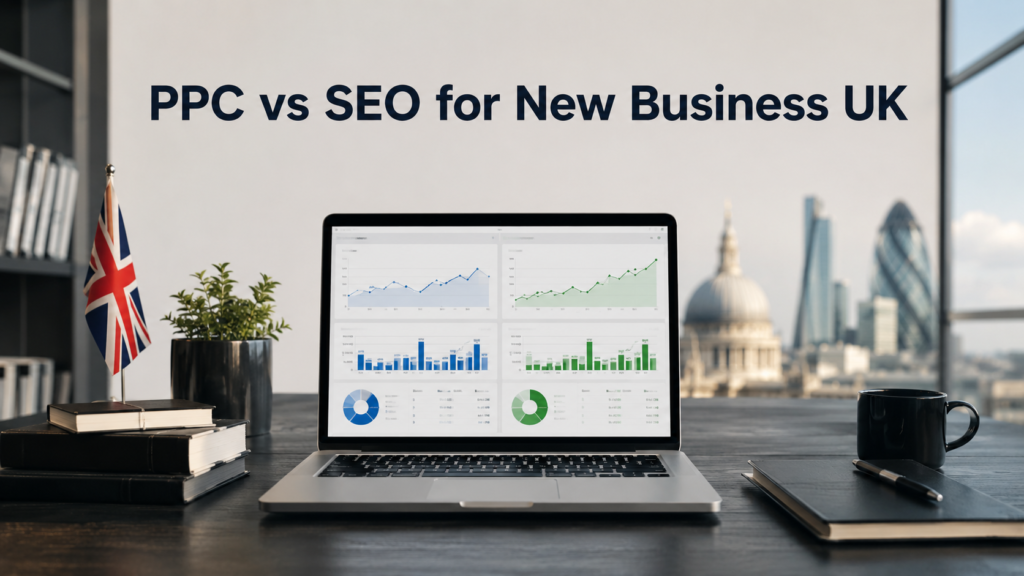
PPC vs SEO for New Business UK: What Is the Difference?
PPC, or pay-per-click advertising, allows businesses to pay for placement on search engines and other advertising platforms. You typically pay when someone clicks on your advertisement. This means you can target specific searches, locations, audiences, and products without waiting months for organic rankings.
SEO, or search engine optimisation, works differently. Instead of paying for every visitor, you improve your website and content so search engines can understand it and consider it useful for relevant searches. Good SEO can attract visitors without a direct cost for each click.
The biggest difference is timing.
With PPC, you can potentially start receiving targeted traffic as soon as your campaign is approved and running. SEO generally takes longer because search engines need time to discover, evaluate, and rank your website.
However, PPC traffic usually stops when you stop paying for advertising. SEO can continue bringing visitors after the initial work has been completed, although rankings still require maintenance and ongoing improvement.
Which One Is Better for a New Business?
There is no universal winner. PPC vs SEO for New Business UK is really a question of what your business needs at its current stage.
If your priority is getting enquiries, sales, or bookings quickly, PPC can be a strong starting point. This is especially useful when you are launching a new service and need immediate visibility while your website is still building its organic presence.
SEO can be more attractive if your goal is long-term growth. A well-optimised website can gradually build authority and attract people who are actively searching for what you offer.
For many new businesses, the smartest approach is not choosing one forever. You can use PPC to generate immediate demand while developing SEO as a longer-term acquisition channel.
Think of PPC as renting visibility and SEO as building an asset. Renting can give you instant access, while building an asset takes longer but may provide lasting value.
When PPC Makes More Sense
PPC is particularly useful when you have a clear commercial offer and know what potential customers are searching for.
For example, imagine a new plumbing company launches in Manchester. Waiting for organic rankings may mean missing customers who need help this week. A carefully targeted paid search campaign could place the business in front of people searching for emergency plumbing services.
PPC also provides useful performance data. You can see which search terms generate clicks, enquiries, and sales. That information can help you understand customer demand and improve other parts of your marketing strategy.
The main challenge is cost control. Competitive keywords can become expensive, and clicks do not automatically turn into customers. A campaign needs relevant landing pages, compelling advertisements, accurate targeting, and regular performance analysis.
Businesses should therefore avoid judging PPC simply by the number of clicks. The important question is whether those clicks produce profitable customers.
Why SEO Is Important for Long-Term Growth
SEO Services can help a new business build a stronger organic presence by improving areas such as website structure, technical performance, content quality, keyword targeting, internal linking, and authority.
The advantage is that SEO can support customers at different stages of the buying journey. Someone may discover an informative article while researching a problem, return later to compare options, and eventually become a customer.
This makes SEO particularly valuable for businesses with products or services that require research before purchase.
The downside is patience. A new website usually cannot expect strong rankings immediately, especially when established competitors already have years of content, links, brand recognition, and search visibility.
That does not mean SEO should be ignored. It means expectations should be realistic. Start by targeting relevant searches where your business has a genuine opportunity to compete rather than attempting to rank for every popular keyword.
How AI SEO Is Changing the Approach
AI SEO is becoming part of modern search marketing, but it should not be treated as a shortcut to instant rankings.
AI tools can help businesses identify content opportunities, organise ideas, analyse search intent, create outlines, find content gaps, and speed up repetitive tasks. For a small business with limited resources, this can make the research and planning process more efficient.
However, simply producing large amounts of AI-generated content is not a reliable SEO strategy. Search engines and customers both benefit from content that is useful, accurate, original, and genuinely relevant.
A new business should use AI as a supporting tool rather than replacing human expertise. Your experience, customer knowledge, examples, opinions, and practical advice are what can make your content different from thousands of generic pages.
The best approach is to combine technology with genuine business knowledge. That creates content that answers real questions instead of simply filling pages with keywords.
Local Visibility Can Be a Major Advantage
For businesses serving a specific area, Local SEO can be especially valuable.
A new restaurant, accountant, dentist, builder, estate agent, consultant, or repair company does not necessarily need visitors from across the country. It needs the right people in the areas it serves.
Local search visibility can help potential customers discover a business when they are looking for nearby products or services. Accurate business information, useful location-focused content, customer reviews, consistent contact details, and a strong local presence can all contribute to better visibility.
This is also where PPC and organic search can complement each other. Paid campaigns can target selected locations immediately, while organic efforts gradually strengthen the business’s local presence.
For a new company, focusing on the customers it can realistically serve is often more productive than trying to compete nationally from day one.
PPC vs SEO for New Business UK: What Should You Choose?
The right choice depends on your situation.
Choose PPC first if you need immediate traffic, have a strong commercial offer, operate in a market where customers actively search for your service, and can track whether advertising produces profitable results.
Prioritise SEO if you are building a long-term brand, have useful knowledge to share, want to reduce dependence on paid traffic over time, and can afford to wait for organic visibility to develop.
For most new businesses, a balanced strategy is often the most practical option. Start with a controlled PPC budget for important commercial searches while building the foundations of SEO at the same time.
For example, you might use PPC to test which services and search terms attract customers. The information from those campaigns can then help shape your website content and organic strategy. As organic visibility improves, you can adjust paid spending towards areas where it delivers the strongest return.
The key is not to treat PPC and SEO as competing marketing channels. They can work together.
A Practical Marketing Approach for a New Business
If your business is just starting, avoid spending your entire budget on advertising before understanding your customers.
First, make sure your website clearly explains what you offer, who you serve, where you operate, and why customers should choose you. Your landing pages should make it easy for visitors to contact you, request a quote, book a service, or make a purchase.
Next, identify the searches that indicate genuine buying intent. These are usually more valuable than broad informational searches when starting a PPC campaign.
At the same time, begin creating useful organic content around the questions your potential customers ask. Build pages for your core services and locations before expanding into broader topics.
Businesses operating in the United Kingdom should also consider regional differences in customer behaviour, competition, terminology, and search demand. A strategy that works for a London-based company may not perform in exactly the same way for a business targeting customers in Birmingham, Glasgow, Cardiff, or smaller towns.
Most importantly, measure business outcomes rather than vanity metrics. Traffic is useful, but enquiries, sales, customer acquisition cost, conversion rate, and revenue provide a much clearer picture of marketing performance.
Final Verdict
So, PPC vs SEO for New Business UK: which is better?
If you need customers quickly, PPC can provide the faster route to visibility. If you want to build sustainable organic traffic and reduce long-term dependence on advertising, SEO deserves serious investment.
For many new businesses, the strongest strategy is to use both intelligently. PPC can provide immediate market exposure and valuable testing data, while SEO builds a foundation that can become increasingly valuable over time.
There is no need to choose based purely on which channel sounds cheaper or more popular. Look at your budget, competition, customer behaviour, sales cycle, and growth goals.
Ultimately, the best marketing strategy is the one that brings the right customers at a sustainable cost. Start small, measure the results, learn what works, and invest more in the channels that consistently contribute to real business growth.