



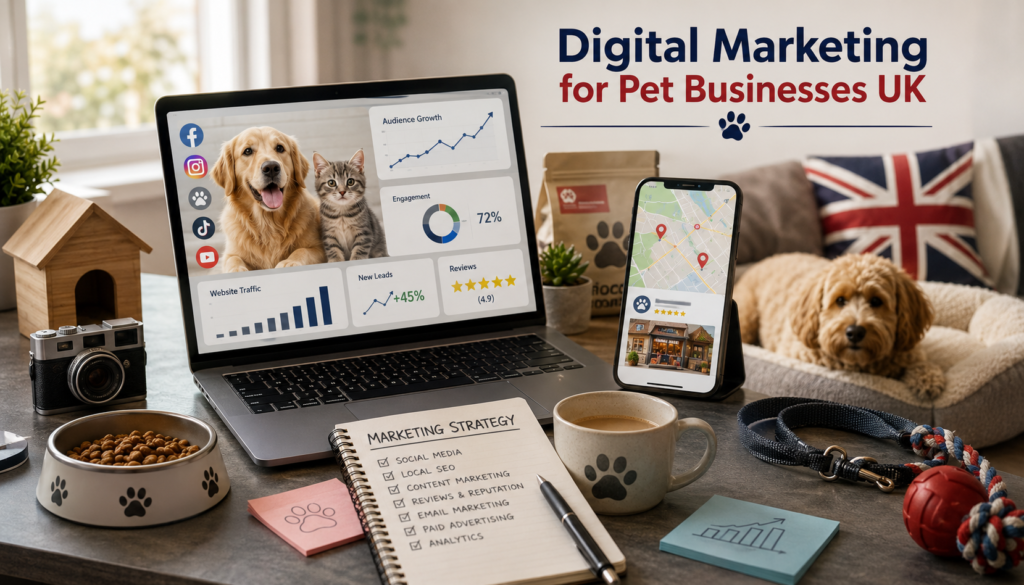
Pet businesses compete in a market where trust, visibility, and customer experience strongly influence buying decisions. From independent pet shops and groomers to dog walkers, boarding facilities, trainers, and specialist pet care providers, customers often research a business online before making contact. A strong Digital Marketing for Pet Businesses UK strategy helps businesses become easier to discover, communicate their value clearly, and turn online interest into bookings and enquiries. The right approach combines search visibility, useful content, local discovery, reputation building, and a website experience designed around what pet owners actually need.
Why Digital Marketing Matters for Pet Businesses
Pet owners rarely choose a service based on price alone. They want confidence that their pets will be treated safely, professionally, and with genuine care. This makes online visibility particularly important because your website, reviews, social profiles, and search presence often create the first impression of your business.
A well-planned marketing strategy can help a pet business appear when customers are actively searching for services, answer questions before they contact you, and demonstrate expertise through helpful information. Instead of simply promoting services, effective marketing creates a clear path from discovery to trust and, eventually, conversion.
For businesses across the United Kingdom, this approach is especially valuable because customers may search for highly specific services within their town, neighbourhood, or nearby area. Understanding these search behaviours allows businesses to create marketing activities that match real customer needs rather than relying on generic advertising.
Build a Website Around Pet Owners
Your website should make it easy for visitors to understand what you offer and decide whether your business is suitable for their pet. A professional design is useful, but usability should remain the priority.
Each major service should have a dedicated page explaining what customers can expect, who the service is suitable for, how the process works, and what makes your business different. For example, a dog grooming business could explain its grooming process, preparation advice, safety practices, and aftercare recommendations.
Trust elements are equally important. Clear contact information, genuine customer reviews, staff introductions, qualifications, photographs, frequently asked questions, and transparent service information can reduce uncertainty. Mobile responsiveness is also essential because many pet owners search for services from their phones.
Your website should also make the next step obvious. Depending on the business, this could be booking an appointment, requesting a quotation, making an enquiry, calling the business, or checking availability.
Create Search-Focused Content
Search visibility should be built around the questions and problems pet owners actually have. Rather than publishing articles simply to fill a blog, identify the information customers need before choosing a service.
For example, a pet grooming business might publish content explaining how often dogs should be groomed, how owners can prepare a nervous dog for its first appointment, or how different coat types require different grooming routines. A boarding business could explain what owners should pack, how boarding works, and how to prepare a pet for its first stay.
This type of content can support SEO Services by creating useful pages around relevant searches while strengthening the overall topical relevance of the website.
Content should be accurate, easy to scan, and genuinely helpful. Strong headings, concise explanations, relevant examples, internal links, descriptive page titles, and clear calls to action can make informational content more useful for both readers and search engines.
Make Local Visibility a Priority
Most pet services operate within a defined geographic area, making location-based visibility one of the most important parts of the strategy. A customer looking for a dog groomer, pet sitter, veterinary-related service, or boarding facility is often interested in businesses they can conveniently reach.
Local SEO helps connect a business with these location-specific searches by improving its presence across relevant local search experiences. Business information should remain accurate and consistent, including the business name, address, phone number, opening hours, website, and service details.
Customer reviews also deserve consistent attention. Genuine reviews can provide valuable social proof and help potential customers understand the experience other pet owners have had. Businesses should encourage satisfied customers to leave honest feedback and respond professionally to reviews rather than treating reputation management as a one-time task.
Local content can strengthen this strategy further. Creating useful pages for genuinely served locations can help communicate where the business operates without producing repetitive pages that offer little value.
Use Social Media to Build Trust
Social media works particularly well for pet businesses because the industry naturally lends itself to visual and educational content. However, the goal should not simply be to collect followers.
A grooming business might share before-and-after transformations with customer permission. A boarding facility could show its environment, daily routines, enrichment activities, and safety procedures. A trainer could demonstrate simple training techniques. A pet shop could explain how customers can choose suitable products for different needs.
Educational posts can also answer common questions in a conversational format. Short videos, photographs, customer stories, behind-the-scenes content, and practical tips can make a business feel more familiar before someone makes contact.
Consistency matters more than posting constantly. A smaller number of useful, authentic posts can build stronger trust than frequent promotional messages with little substance.
Use AI Without Losing Authenticity
Artificial intelligence can help pet businesses research topics, organise content ideas, identify common questions, and improve the efficiency of marketing workflows. However, technology should support expertise rather than replace it.
AI SEO can be incorporated into a broader strategy by helping businesses understand conversational searches, organise information clearly, identify related topics, and prepare content for increasingly intelligent search experiences. The strongest results still depend on useful information, genuine experience, accurate claims, and content created around real customers.
For example, a pet trainer can use technology to identify common questions about puppy behaviour, but the final content should reflect practical experience and explain solutions in a way that pet owners can actually follow.
Businesses should also review AI-assisted content carefully. Generic or repetitive articles can make a website feel less trustworthy. Original insights, real examples, expert commentary, and first-hand knowledge make content more valuable.
Turn Reviews Into a Marketing Asset
Reviews should be treated as part of the customer’s decision-making journey rather than simply a ranking factor. When choosing someone to care for their pet, customers want reassurance that other owners have had positive experiences.
A good review strategy begins with delivering an excellent service. Businesses can then make it easy for satisfied customers to provide honest feedback. Reviews that naturally describe punctuality, communication, cleanliness, staff behaviour, pet handling, or service quality can answer questions prospective customers may already have.
Responding to reviews also matters. A thoughtful response to positive feedback shows appreciation, while a professional response to criticism demonstrates accountability. Businesses should avoid arguing publicly with customers or using repetitive responses that feel automated.
The best reputation strategy is therefore operational as much as promotional: deliver a strong experience, communicate clearly, request genuine feedback, and use customer insights to improve the service.
Measure What Actually Matters
Marketing performance should not be judged only by website traffic or social media followers. Pet businesses need to understand whether their marketing is producing meaningful customer actions.
Useful measurements can include organic search visibility, relevant website visits, enquiry volume, appointment bookings, calls, booking-form completions, location-based interactions, and conversions from important service pages.
It is also useful to identify which services generate the strongest demand. If searches and enquiries consistently increase for one particular service, the business can strengthen that page, create supporting educational content, and make the booking journey easier.
Regular measurement allows businesses to invest more confidently. Instead of continuing activities simply because they have always been used, owners can identify what attracts qualified customers and refine their strategy accordingly.
Create a Consistent Customer Journey
The most effective marketing strategies connect different channels instead of treating every activity separately. A customer might discover a business through a search result, read a helpful article, check reviews, visit the website, look at social media, and then book an appointment.
Every stage should provide consistent information and reinforce the same message. Service descriptions should match across platforms. Contact details should be accurate. Pricing information should not contradict other pages. Brand communication should feel professional but approachable.
This consistency reduces friction and makes the business easier to trust. It also helps customers move from curiosity to action without having to search repeatedly for basic information.
A Practical Strategy for Long-Term Results
A strong Digital Marketing for Pet Businesses UK strategy does not depend on one promotional channel. It combines a useful website, customer-focused content, search visibility, local discovery, social proof, reputation management, and measurable conversion opportunities.
The most important step is to understand the customer first. Identify what pet owners search for, what concerns them, what information they need before booking, and what makes them choose one provider over another. Then build your digital presence around those needs.
Digital marketing becomes far more effective when every activity has a clear purpose. Instead of chasing visibility alone, pet businesses can focus on becoming the trusted answer when customers need help. With consistent execution, useful information, authentic expertise, and a customer-friendly online experience, Digital Marketing for Pet Businesses UK can become a dependable source of qualified enquiries and long-term customer relationships.