



Search visibility can change dramatically when a website violates Google’s quality guidelines or loses trust due to manipulative SEO practices. For businesses investing in SEO Services, understanding what causes a ranking decline is essential because not every traffic drop is a penalty. A genuine Google penalty can reduce organic visibility, affect valuable landing pages, and make it difficult for potential customers to find a business through search.
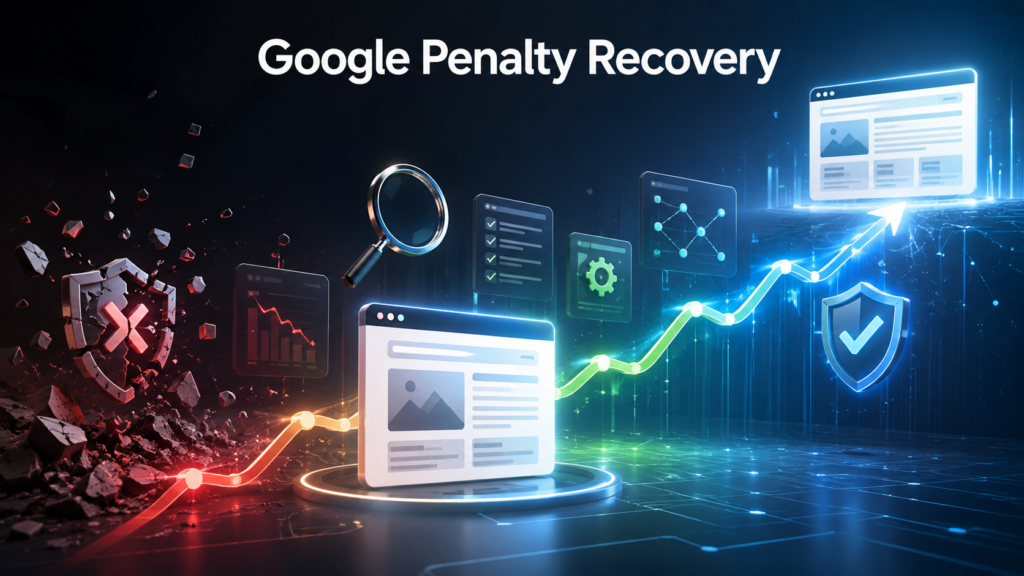
The process of Google Penalty Recovery begins with identifying the real reason behind the decline rather than making random changes. For businesses targeting customers in the United Kingdom, this distinction is particularly important because search performance can influence local visibility, leads, and revenue. Before taking corrective action, website owners need to determine whether Google has issued a manual action or whether an algorithmic change has affected the site’s rankings.
What Is a Google Penalty?
A Google penalty is a negative action taken against a website when Google determines that the site violates its spam policies or uses practices designed to manipulate search rankings. The consequences can range from losing rankings for specific pages to having large portions of a website removed from search results.
Google generally deals with problematic websites in two broad ways: manual actions and algorithmic impacts.
A manual action occurs when Google’s reviewers identify a violation of its guidelines. In this situation, website owners can usually see information about the issue in Google Search Console. The report may explain which parts of the site are affected and what type of violation needs to be addressed.
Algorithmic impacts are different. A website may experience a significant ranking decline after Google updates its search systems, without receiving a manual-action notification. This does not necessarily mean the site has been “penalized.” The algorithm may simply have determined that other pages provide better quality, relevance, originality, or user experience.
Understanding this difference is the first step toward choosing the right recovery strategy.
Common Reasons Websites Lose Google Rankings
Google evaluates websites using many signals related to content quality, relevance, usability, reputation, and spam. A website can therefore lose visibility for several reasons.
One common issue is unnatural link building. Buying backlinks, participating in link schemes, creating large numbers of low-quality links, or using links primarily to manipulate rankings can create problems.
Thin or low-value content is another concern. Pages created mainly to capture search traffic without providing meaningful information may struggle to perform, particularly when competing websites offer more comprehensive answers.
Keyword stuffing can also damage a site’s search performance. Repeating the same phrase excessively makes content difficult to read and can create an unnatural experience for visitors.
Other potential problems include automatically generated pages with little value, doorway pages, hidden text, deceptive redirects, scraped content, and misleading structured data.
It is also worth remembering that technical problems can cause substantial ranking losses without representing a penalty. Accidental noindex directives, server errors, broken internal links, poor mobile usability, or incorrect canonical tags can all interfere with search visibility.
How to Tell If Your Website Has Been Penalized
The first step is to avoid assuming that every ranking drop is a penalty.
Start by checking Google Search Console for notifications under the manual actions section. If Google has identified a direct violation, the report can provide an important clue about what needs to be corrected.
Next, examine the timing of the decline. If traffic dropped suddenly around the time of a major Google algorithm update, investigate whether the site’s content, relevance, or overall quality may have been affected.
Look at the decline itself. Did the entire domain lose visibility, or did only certain pages fall? Did branded searches remain stable while non-branded queries declined? Did impressions decrease while rankings stayed similar? These details can help distinguish between a technical problem, changing search demand, increased competition, and a possible quality-related issue.
Analytics data should also be reviewed. Compare organic traffic before and after the decline and identify the pages, queries, countries, and devices most affected.
A Practical Approach to Google Penalty Recovery
Effective recovery requires diagnosis before implementation. Making dozens of changes simultaneously can make it difficult to determine which action solved the problem.
If a manual action has been issued, read Google’s explanation carefully and identify every affected area. Correct the underlying issue across the website rather than fixing only a few visible examples.
For backlink-related problems, conduct a thorough link audit. Look for suspicious, manipulative, or clearly unnatural links and determine whether they were created intentionally, obtained through questionable tactics, or generated through other circumstances. Where appropriate, take steps to remove problematic links and follow Google’s recommended process for addressing unnatural links.
Content problems require a different approach. Review pages from the perspective of a real visitor. Does each page answer the searcher’s question clearly? Is the information accurate and sufficiently detailed? Does the page offer original value, or does it simply repeat information already available elsewhere?
Pages that provide little value may need to be substantially improved, consolidated, or removed when appropriate.
Improve Content Quality Instead of Chasing Rankings
Recovery should not be treated as an exercise in inserting more keywords. Google’s systems are designed to understand topics, context, search intent, and content usefulness.
Start by identifying the purpose of each important page. A product page should help users understand the product. A service page should explain what is offered, who it is for, and why the service is useful. An informational article should provide a clear and trustworthy answer to the user’s question.
Strong content should also be easy to navigate. Use descriptive headings, logical sections, concise paragraphs, relevant examples, and useful supporting information.
Accuracy matters as well. Review outdated claims, statistics, references, and recommendations. Where appropriate, demonstrate expertise through first-hand information, credible sources, author information, and transparent explanations.
This approach can be especially valuable when developing AI SEO strategies because automation should support research, organization, and efficiency rather than replace editorial judgment. Content still needs human oversight and genuine value.
Technical Factors That Should Be Checked
A recovery strategy should include a technical review because search visibility can be affected by issues unrelated to content quality.
Check whether important pages can be crawled and indexed. Review robots.txt directives, meta robots tags, canonical URLs, XML sitemaps, redirects, status codes, and internal linking.
Website performance also deserves attention. Slow pages, intrusive interstitials, poor mobile experiences, and difficult navigation can negatively affect users and may contribute to weaker search performance.
Pay attention to duplicate pages as well. Similar URLs can sometimes create confusion about which version should appear in search results. A logical URL structure and appropriate canonicalization can help search engines understand the preferred version.
Security should not be overlooked. Hacked pages, malicious redirects, spam injections, or compromised website sections can create serious search visibility problems.
Local Visibility and Reputation Matter Too
For businesses that depend on customers in specific geographic areas, search recovery should extend beyond traditional organic rankings. Local SEO depends on accurate business information, relevant local content, strong website signals, and a trustworthy presence across the search ecosystem.
Review business details for consistency, make sure important location pages provide genuine value, and avoid creating multiple low-quality pages simply to target every nearby town or neighborhood.
Customer reviews and reputation can also influence how people perceive a business after discovering it in search. While reviews are not a simple shortcut to recovering organic rankings, a credible online presence supports user trust and can strengthen the overall customer journey.
How Long Does Google Penalty Recovery Take?
There is no universal recovery timeline.
The duration depends on the type of problem, the number of affected pages, the severity of the violation, how quickly the issues are corrected, and how Google subsequently evaluates the website.
Manual actions may require a reconsideration request after the underlying problems have been addressed. A reconsideration request should clearly explain what was wrong, what has been changed, and what steps have been taken to prevent the problem from happening again.
Algorithm-related declines may take longer to understand because there is no simple penalty notification to resolve. In those cases, recovery often depends on improving the site’s overall quality, relevance, usefulness, and technical health.
Mistakes to Avoid During Recovery
One of the biggest mistakes is making changes without understanding the cause of the decline. Removing large numbers of pages, changing URLs unnecessarily, or rewriting an entire website overnight can create additional problems.
Another mistake is focusing exclusively on backlinks. Although links can be important, rankings depend on many factors. A website with technically clean links can still perform poorly if its content does not satisfy search intent.
Avoid shortcuts promising instant recovery. Services that guarantee specific rankings or recommend aggressive link-building tactics can create more risk.
Finally, do not expect recovery to happen immediately after making changes. Search engines need time to recrawl pages, process changes, and reassess their quality.
Building a Website That Is Less Vulnerable to Future Penalties
The best recovery strategy is to create a website that does not rely on manipulative tactics in the first place.
Publish useful information for real audiences, maintain technical quality, earn links naturally, monitor Search Console regularly, and review important pages as information changes.
SEO should be treated as an ongoing process rather than a one-time campaign. Search behavior changes, competitors improve their websites, and Google’s systems continue to evolve. Regular audits can help identify technical problems, outdated content, suspicious links, and declining pages before they become major issues.
Most importantly, focus on the experience that visitors receive. A website that consistently answers questions, solves problems, demonstrates credibility, and makes information easy to access is better positioned for sustainable organic visibility.
Final Thoughts
A Google penalty can be serious, but a ranking decline does not automatically mean that a website has been penalized. The most effective Google Penalty Recovery process starts with accurate diagnosis, followed by systematic correction of technical, content, link, or quality-related problems. Businesses should resist quick fixes and focus instead on building a trustworthy website that genuinely serves its audience. When recovery is approached strategically, patiently, and with the principles of Google’s quality guidelines in mind, a lost position in search can become an opportunity to build a stronger and more sustainable organic presence.