

Search has changed quietly, but the impact on websites is anything but small. A person can search for a question, find a definition, compare products, check a business, read a summary, or even make a decision without ever visiting a website.
That shift is reshaping how businesses think about organic visibility.
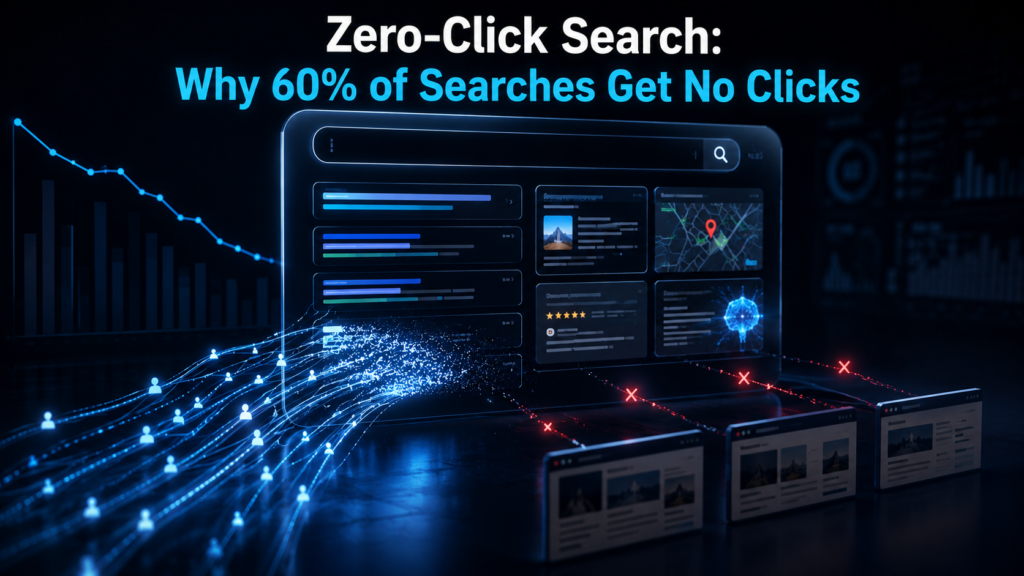
The headline “60% of searches end without a click” comes from 2024 research showing that 58.5% of U.S. Google searches and 59.7% of European Union searches ended without a click. More recent research from 2026 puts the U.S. figure at 68.01%, showing that the trend has continued rather than reversed.
So, if your website traffic is falling even though your rankings appear stable, the problem may not be your content. The search experience itself is changing.
What Is a Zero-Click Search?
A zero-click search happens when someone searches for something but does not click through to another website.
The answer may already be visible on the search results page. Google can provide definitions, calculations, weather information, business details, maps, product information, featured snippets, knowledge panels, and increasingly AI-generated summaries.
For example, imagine someone searches, “How many calories are in an apple?” If the answer is displayed immediately, there is little reason to open a result.
The same happens with informational searches such as “What is inflation?” or “When does the UK tax year end?” The searcher may get enough information from the results page to stop searching.
This does not necessarily mean the user had a bad experience. In fact, the opposite can be true: search has become faster because users can get useful information without navigating through several websites.
The challenge is that publishers and businesses traditionally depended on that visit.
Why Search Engines Are Keeping Users on the Results Page
Search engines have spent years making results pages more useful. The objective is simple: help users complete more tasks with fewer steps.
That has produced a search environment filled with interactive features and direct answers.
A search for a nearby restaurant can display opening hours, reviews, directions, photographs, and contact information. A sports query can show scores and schedules. A financial query may display market information. A question may produce a featured answer before traditional organic listings.
AI has accelerated this development. AI-generated search experiences can summarize information from multiple sources, reducing the need for users to open individual pages.
The result is a fundamental change in the relationship between visibility and traffic.
A page can be seen without being visited. A brand can influence a decision without receiving a referral session. Content can contribute to an answer even when its URL is never opened.
That means clicks are becoming only one measurement of search success.
How SEO Needs to Adapt to the Zero-Click Era
Traditional SEO Services often focused heavily on rankings, keywords, backlinks, and organic sessions. Those metrics still matter, but they no longer tell the entire story.
Modern search strategy needs to consider what happens before the click.
Content should answer important questions clearly enough to be understood by both people and search systems. Pages should demonstrate genuine expertise, use reliable information, address search intent directly, and make the next step obvious when a visitor does arrive.
This is also where AI SEO becomes relevant. Search systems increasingly rely on machine-generated summaries and AI-assisted discovery, so businesses need content that is easy to understand, well structured, factually dependable, and supported by recognizable expertise.
The goal is not simply to “beat” AI-generated answers. It is to make your brand and information valuable enough to appear as a source, earn recognition, and remain relevant when users move from research to action.
The Biggest Mistake: Measuring Only Website Traffic
Falling organic traffic can look alarming in an analytics report. But traffic alone cannot tell you whether your search visibility is becoming less valuable.
Consider two businesses.
Business A receives 10,000 visits from broad informational searches. Most visitors read one article and leave.
Business B receives 3,000 visits, but many come from searches involving specific services, products, locations, or brand names. Those visitors are much closer to making a purchase.
Business B could generate more revenue despite receiving less traffic.
This is why marketers need to examine the entire search journey. Rankings, impressions, branded searches, conversions, assisted conversions, calls, enquiries, purchases, and returning visitors can reveal more than sessions alone.
A decline in clicks does not automatically mean your strategy has failed. It may mean the search environment has changed and your measurement model has not caught up.
Not Every Search Is Equally Vulnerable
Informational searches are particularly exposed to zero-click behavior.
Queries such as “what is,” “how many,” “when,” “where,” and simple definitions can often be answered directly in search results. There is little motivation to visit another website when the user needs only a short factual response.
Commercial and transactional searches are different.
Someone searching for “best accounting software” may still want comparisons and detailed reviews. A person searching for “emergency plumber near me” has a strong reason to contact a business. Someone looking for a specific company may deliberately click through to its website.
This distinction matters because businesses should not try to win every possible query in exactly the same way.
The smarter approach is to understand which searches create awareness, which create consideration, and which create action.
How to Build Visibility When the Click Is Optional
The first step is to stop treating every search impression as a missed click.
Your content should provide immediate value while also giving users a reason to remember your brand. A strong article can answer the main question quickly, then offer deeper explanations, original research, examples, tools, opinions, or practical guidance.
Original information is particularly valuable because generic summaries are easier for search engines and AI systems to reproduce.
Businesses should also strengthen brand recognition. When users repeatedly encounter the same company across search results, social platforms, videos, industry publications, communities, and other channels, they become more likely to search for that brand directly.
Another important shift is creating content for different stages of intent.
An educational article may introduce a problem. A comparison page can help someone evaluate solutions. A service page can address purchase intent. A case study can provide proof. A well-designed landing page can turn existing demand into an enquiry.
The objective is to create a connected journey rather than expecting one blog post to generate a sale immediately.
Why Local and Branded Searches Still Matter
Local SEO deserves particular attention because location-based searches often have a strong action component.
When someone searches for a service nearby, they may want directions, a phone number, opening hours, availability, reviews, or an appointment rather than a lengthy educational article.
Businesses operating in the United Kingdom, for example, can benefit from making their location, services, contact information, reviews, and business details consistent and easy to understand across their online presence.
The broader lesson is important: not every search needs to produce a website visit to create business value.
A user may see your business in a map result, remember your name, search for the brand later, call directly, or visit your physical location. If your reporting counts only organic website sessions, those interactions can disappear from the picture.
What Businesses Should Do Next
The zero-click trend does not mean that search optimization is dead. It means the definition of success is expanding.
The most effective strategy is to combine visibility with usefulness. Give people the answer they need, demonstrate why your brand deserves trust, and make it easy for high-intent users to take the next step.
Audit your existing search performance and separate informational queries from commercial, local, branded, and transactional ones. Look for pages that receive impressions but few clicks, then determine whether the search intent is naturally satisfied on the results page.
At the same time, identify the queries where a click genuinely matters. Improve those pages with stronger evidence, clearer calls to action, original insights, better user experience, and content that goes beyond what a search summary can provide.
Most importantly, do not panic when traffic declines without examining the reason.
Search is becoming less about sending every user to a website and more about influencing the entire decision journey.
The Future of Search Is Bigger Than the Click
The internet is moving toward a model where answers can appear before the website visit. The latest data makes that difficult to ignore: the share of Google searches ending without a click has risen substantially, reaching 68.01% in the first four months of 2026 in SparkToro’s analysis of Similarweb clickstream data.
That does not make websites irrelevant.
It makes valuable websites more important.
When a user finally decides to click, the page needs to offer something worth leaving the search results for: depth, originality, evidence, tools, products, services, expertise, or a clear path to action.
The businesses that adapt will stop asking only, “How much traffic did we get?”
They will ask better questions:
Did the right people discover us? Did our brand become more memorable? Did our content influence the decision? Did high-intent searches lead to enquiries or sales? And did our expertise become visible even when the click never happened?
That is the real shift behind the rise of zero-click search. The click is no longer the entire destination. It is one part of a much larger search journey.