


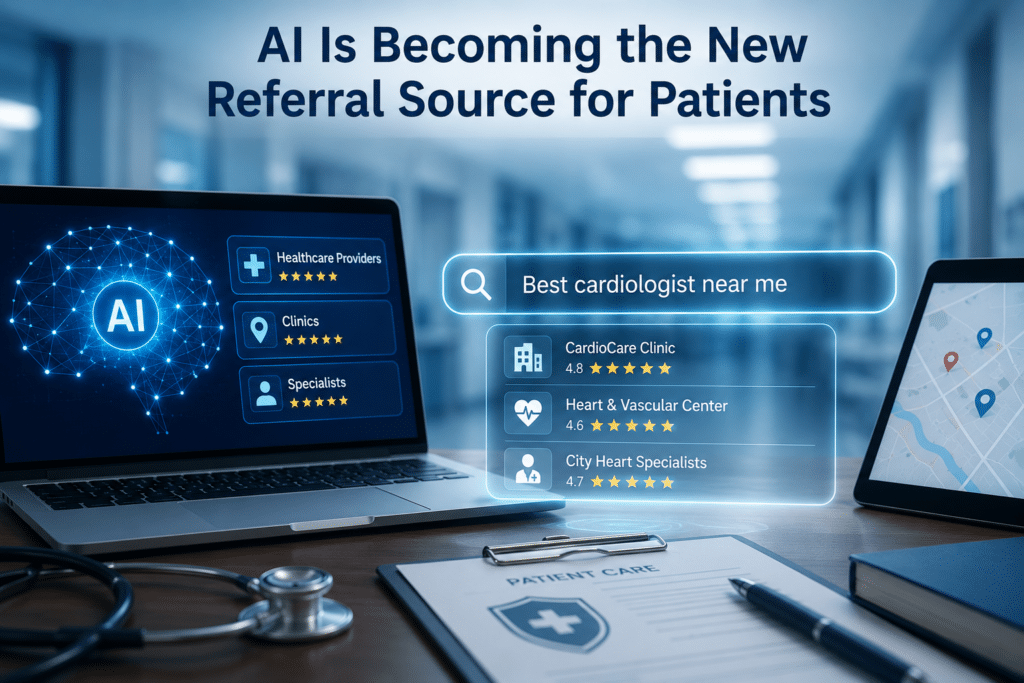
A patient no longer has to begin their healthcare journey by searching for a hospital, clinic, or specialist by name. Increasingly, they can ask an AI-powered search engine a complete question and receive a summarized answer, a list of suggested providers, or guidance on what to consider next.
That changes an important part of healthcare marketing: being visible is no longer only about appearing in traditional search results. Your healthcare brand also needs to be understood, trusted, and considered by the systems generating those answers.
For healthcare organizations, this creates a new form of digital discoverability. A patient may never visit ten different websites before making a decision. Instead, an AI system may help narrow those choices for them. The brands that consistently provide clear, credible, useful information have a better opportunity to become part of that consideration process.
How Patients Are Changing the Way They Search for Healthcare
Healthcare searches have always been different from many commercial searches because patients often begin with a problem rather than a provider.
Someone may search for symptoms, treatment options, potential causes, recovery expectations, or questions about whether they should speak to a specialist. Historically, these searches produced pages of links that patients had to evaluate themselves.
AI-powered search is changing that experience.
Instead of presenting only a list of webpages, modern search experiences can interpret a question, combine information from multiple sources, and provide a conversational response. Patients can then ask follow-up questions without starting the search process again.
This creates a more complicated visibility challenge for healthcare brands.
A website might rank reasonably well for a particular keyword but still fail to become part of an AI-generated answer. Conversely, a healthcare organization with strong expertise, useful educational content, clear services, and credible supporting information may become more recognizable within AI-driven discovery.
The key difference is that ranking and being referenced are increasingly separate concepts.
Traditional search asks, “Which pages should appear for this query?”
AI search increasingly asks, “Which information can help answer this question accurately?”
Healthcare organizations therefore need to think beyond individual rankings and focus on becoming a reliable source of information across an entire topic.
Why AI Search for Healthcare Depends on Trust
Healthcare is one of the areas where trust matters most.
A patient searching for a restaurant can tolerate an imperfect recommendation. A patient researching surgery, cancer treatment, chronic conditions, mental health support, or specialist care expects information to be accurate and responsible.
That makes AI search for healthcare particularly dependent on signals that demonstrate expertise and credibility.
AI systems need enough context to understand who is publishing information, what expertise supports it, how specific claims are substantiated, and whether the information appears reliable.
This is why simply producing large amounts of generic healthcare content is unlikely to create lasting visibility.
A stronger approach is to build content around genuine expertise. For example, a healthcare organization could explain a treatment from several relevant perspectives: who may benefit from it, how the process works, potential risks, preparation requirements, recovery considerations, and questions patients should discuss with a qualified professional.
The information should also make its source clear.
Author credentials, medical reviewers, references where appropriate, transparent service information, updated content, and clear explanations of limitations can all contribute to a stronger trust framework.
The objective isn’t to write content specifically to manipulate an AI system.
It is to create information that a patient, healthcare professional, and search system can all understand and evaluate with confidence.
Building Content AI Can Understand and Patients Can Trust
A major challenge for healthcare organizations is turning specialist knowledge into content that is both medically responsible and easy to understand.
This is where working with a healthcare seo agency can become useful—not simply for keyword placement, but for developing a broader content and search strategy around patient intent.
Strong healthcare content should answer the questions patients genuinely ask.
Consider a patient researching knee replacement. A weak article might provide a short definition and repeatedly mention “knee replacement” throughout the page.
A stronger resource could address:
- When knee replacement may be considered
- Common symptoms that lead patients to seek specialist advice
- What happens during the procedure
- Typical preparation requirements
- Recovery and rehabilitation
- Potential risks and complications
- Questions to ask a specialist
- When urgent medical advice may be necessary
This structure gives search systems more meaningful information to interpret while making the page substantially more useful to the reader.
Healthcare content also benefits from clear organization. Descriptive headings, concise explanations, internal links between related topics, structured data where appropriate, and easily identifiable authorship help both users and search technologies understand the page.
Most importantly, the content should not promise outcomes that cannot be guaranteed.
Trust is strengthened when healthcare information communicates uncertainty responsibly rather than presenting every treatment as universally effective.
From Keywords to Complete Patient Questions
Traditional healthcare seo often focused heavily on identifying keywords with search volume and optimizing individual pages around those phrases.
Keyword research remains useful, but patient journeys are rarely built around one search term.
A patient might progress through several questions:
“Why does my shoulder hurt?”
Then:
“When should I see a shoulder specialist?”
Then:
“What treatments are available for a rotator cuff injury?”
And eventually:
“Which specialist treats this condition near me?”
These searches represent different stages of decision-making.
An effective content strategy should therefore connect informational, comparative, and local intent rather than treating every query as an isolated opportunity.
This is particularly important for AI-powered search because conversational systems can connect related questions within a single interaction. If your website comprehensively covers a subject, it provides a broader body of information that can help establish topical relevance.
For example, instead of publishing one article about diabetes, a healthcare organization could develop an interconnected information hub covering symptoms, diagnosis, treatment approaches, lifestyle considerations, medication questions, monitoring, specialist care, and frequently asked patient questions.
The result is not simply more content.
It is better coverage of the patient decision journey.
What Healthcare Websites Need to Become AI-Ready
Becoming more discoverable through AI does not require creating content exclusively for machines. In fact, the opposite is generally more useful.
Healthcare websites should first be built around patient needs and accurate information.
Several foundational elements deserve particular attention.
Clear Expertise
Patients should be able to understand who is providing the information and why that person or organization is qualified to discuss the subject.
Strong Topic Coverage
Important healthcare topics should be addressed comprehensively rather than through thin pages created primarily to target individual queries.
Evidence and Transparency
Where appropriate, healthcare claims should be supported with reputable evidence, references, clinical guidance, or other authoritative sources.
Updated Information
Medical knowledge and clinical guidance can change. Important pages should have appropriate review and update processes rather than remaining untouched for years.
Strong Local Signals
For patients looking for nearby healthcare providers, accurate location information, service details, practitioner profiles, and consistent business information can help connect online discovery with real-world care.
Technical Accessibility
Search engines and AI systems need to be able to access, crawl, interpret, and understand website content. Poor technical performance can undermine even excellent healthcare information.
These elements work together. There is rarely one optimization technique capable of making a healthcare brand consistently visible across every search environment.
Where Healthcare SEO Services Fit Into the New Search Landscape
The role of healthcare seo services is increasingly broader than improving conventional rankings.
A modern strategy should examine how patients search, what questions they ask at different stages, which topics demonstrate genuine expertise, and how clearly a healthcare organization communicates its authority online.
It should also consider the relationship between content and the wider digital ecosystem.
Provider profiles, reputable third-party mentions, reviews, professional organizations, medical publications, local listings, and consistent brand information can all contribute to how a healthcare organization is understood online.
This matters because AI-generated answers do not necessarily rely on one webpage.
They can draw from multiple sources when constructing an answer. A healthcare brand therefore benefits from having a consistent and credible digital presence rather than relying entirely on its own website.
For organizations operating across the United Kingdom, this becomes particularly important because patients may search using different terminology, regional language, local healthcare expectations, and provider-specific questions.
The strategy should reflect the audience’s actual search behavior rather than assuming that one global content approach will work equally well everywhere.
Measuring Visibility Beyond Website Traffic
One of the biggest mistakes healthcare marketers can make is assuming that website traffic is the only meaningful measure of search success.
AI-generated answers can satisfy part of a patient’s information need without requiring an immediate website visit.
That means a healthcare brand could gain visibility even when traditional click-through metrics do not fully capture it.
Measurement should therefore expand to include indicators such as:
- Visibility for important patient questions
- Brand mentions within AI-generated search experiences
- Growth in branded searches
- Engagement with educational content
- Local discovery and provider searches
- Appointment-related conversions
- Calls and enquiries
- Assisted conversions across multiple channels
The goal is to understand whether search visibility is influencing patient consideration—not simply whether every search produces a website click.
The New Healthcare Discovery Journey
AI is not eliminating traditional search. Instead, it is adding another layer to how people discover and evaluate healthcare providers.
Patients may still use Google, maps, provider directories, hospital websites, reviews, and referrals. But AI can increasingly sit between the initial question and the final decision.
That makes visibility more nuanced.
A healthcare brand needs to be present where patients research their problems, understand treatments, compare options, and identify providers. More importantly, the information surrounding that brand needs to be accurate, consistent, authoritative, and genuinely useful.
AI search for healthcare is therefore not simply another SEO trend. It represents a shift toward a search environment where the quality and credibility of information can influence which healthcare organizations enter the patient’s consideration set.
The organizations that prepare for this shift will not focus only on ranking pages. They will build a trustworthy information ecosystem that helps patients find reliable answers—and gives AI systems strong reasons to recognize their expertise.
Because when AI becomes part of the referral journey, being found is no longer enough. Your healthcare brand needs to be understood and trusted.