

Why Most Websites Never Reach Page One
Every business owner wants visibility, traffic, and leads from Google, but very few people explain what actually moves a website toward the top search results. Most online advice focuses on shortcuts, outdated tricks, or overly technical explanations that confuse beginners and frustrate growing businesses.
The reality is that learning how to get your website on google first page has less to do with secret hacks and more to do with consistency, search intent, technical quality, and trust. Google’s ranking systems are designed to reward websites that genuinely help users solve problems quickly and accurately.
Many websites fail because they only focus on publishing content without understanding how Google evaluates authority, user behavior, page quality, and relevance. Ranking today requires a balance between strategy, user experience, optimization, and long-term credibility.
Google Does Not Rank Websites Randomly
One of the biggest misconceptions in digital marketing is that rankings are luck-based. They are not. Google evaluates thousands of signals before deciding where a page belongs in search results.
These signals include:
- Content relevance
- Website speed
- Mobile usability
- User engagement
- Internal linking
- Search intent matching
- Backlink quality
- Topic authority
- Brand trust
If your website solves a search query better than competitors, Google gradually increases your visibility. However, websites that publish generic or repetitive content often struggle to gain traction.
Businesses investing in modern search strategies such as SEO UK campaigns are increasingly focusing on expertise and content depth rather than keyword stuffing or mass publishing.
Content Quality Is No Longer Optional
Years ago, websites could rank with short articles filled with repeated keywords. That approach no longer works consistently. Google now prioritizes content that demonstrates experience, accuracy, and usefulness.
A strong article should answer the user’s question completely while also guiding them toward related information. Thin pages with little value are often ignored, even if the technical SEO is acceptable.
This is especially important for industries where trust matters heavily. For example, a healthcare seo agency working with hospitals or clinics must create medically accurate content that reflects expertise and reliability.
Similarly, businesses using healthcare seo services now focus more on authority-building content rather than publishing hundreds of low-quality pages.
Search Intent Is More Important Than Keywords Alone
Many websites fail because they target keywords without understanding why users search for them. Search intent determines whether someone wants information, comparisons, services, products, or direct solutions.
For example, a user searching “best accounting software” expects comparisons and recommendations, while someone searching “accounting software pricing” is much closer to making a purchase decision.
Google studies user behavior closely. If visitors leave your page quickly because it does not satisfy their intent, rankings can decline over time.
This is why professional optimization strategies used by a medical seo agency often involve deep intent analysis before content creation even begins.
Businesses offering medical seo services also focus heavily on aligning content structure with what users genuinely expect to see on a page.
Technical SEO Quietly Impacts Rankings
Many people focus only on blog writing and ignore technical performance. However, technical SEO acts as the foundation of your website. Even excellent content can struggle if your site loads slowly or has indexing problems.
Important technical factors include:
- Fast loading speeds
- Secure HTTPS connection
- Mobile responsiveness
- Proper heading structure
- Clean URL architecture
- Internal linking
- Crawlability
- Schema markup
Google wants users to have a smooth experience. If your website feels broken, cluttered, or slow, rankings become harder to achieve.
Today, many healthcare seo companies spend as much time fixing technical infrastructure as they do creating content because performance directly affects visibility.
Authority Takes Time to Build
One thing nobody talks about enough is patience. Most websites do not rank overnight. Google needs time to understand your site, evaluate your consistency, and compare your authority against competitors.
Authority is built through:
- Helpful content
- Consistent publishing
- Natural backlinks
- Positive user engagement
- Brand mentions
- Industry relevance
The more your website becomes associated with expertise in a topic, the easier future pages can rank.
This is especially true in competitive industries where healthcare seo strategies require ongoing optimization rather than one-time improvements.
AI Is Changing SEO Faster Than Most Businesses Realize
Artificial intelligence is rapidly influencing search rankings, content evaluation, and user behavior. Google’s algorithms are becoming better at understanding meaning instead of simply matching keywords.
Businesses now use tools powered by automation, predictive analysis, and machine learning to improve optimization strategies. However, AI should support human expertise rather than replace it.
Modern ai seo services are increasingly focused on identifying search trends, improving content structures, and analyzing competitor gaps more efficiently.
At the same time, businesses investing in an ai seo service still need human oversight to ensure content quality, originality, and accuracy remain strong.
User Experience Influences Rankings More Than Ever
Google tracks how users interact with your website. If visitors stay longer, navigate multiple pages, and engage positively with content, Google sees those as quality signals.
User experience includes:
- Clear navigation
- Readable layouts
- Mobile-friendly design
- Logical content flow
- Fast page loading
- Helpful calls-to-action
A confusing website structure can negatively impact rankings even if the content itself is valuable.
This is why many companies are now integrating ai optimisation services alongside design improvements to better understand user behavior and engagement patterns.
Local SEO Creates Faster Visibility Opportunities
Competing nationally can take years, especially for new websites. Local visibility often provides faster opportunities for businesses trying to generate leads and traffic.
Local optimization focuses on:
- Google Business Profile optimization
- Local citations
- Area-specific landing pages
- Location-based keywords
- Reviews and trust signals
For service businesses, local rankings can generate highly targeted traffic with stronger conversion potential.
Many businesses investing in Local SEO UK strategies prioritize geographic relevance because local intent searches often convert better than broader keywords.
Backlinks Still Matter – But Quality Matters More
Backlinks remain one of Google’s strongest ranking signals, but not all links carry equal value. A few authoritative links from trusted websites are usually far more effective than hundreds of weak links.
Good backlinks typically come from:
- Industry publications
- Relevant blogs
- Research mentions
- News websites
- Partnerships
- Useful resources
Buying random links or participating in spammy link schemes can hurt rankings instead of helping them.
Google’s systems are becoming increasingly effective at detecting unnatural link patterns, making quality-based link building far more important than quantity.
Why Consistency Beats Short-Term SEO Tricks
Many websites fail because they stop optimizing too early. SEO rewards consistency over time. Publishing one great article is helpful, but long-term growth usually comes from maintaining quality across an entire website.
Consistent improvement includes:
- Updating old pages
- Expanding topical coverage
- Improving internal linking
- Refreshing outdated information
- Monitoring search trends
- Enhancing user experience
Websites that continuously evolve often outperform competitors relying on outdated tactics or occasional optimization efforts.
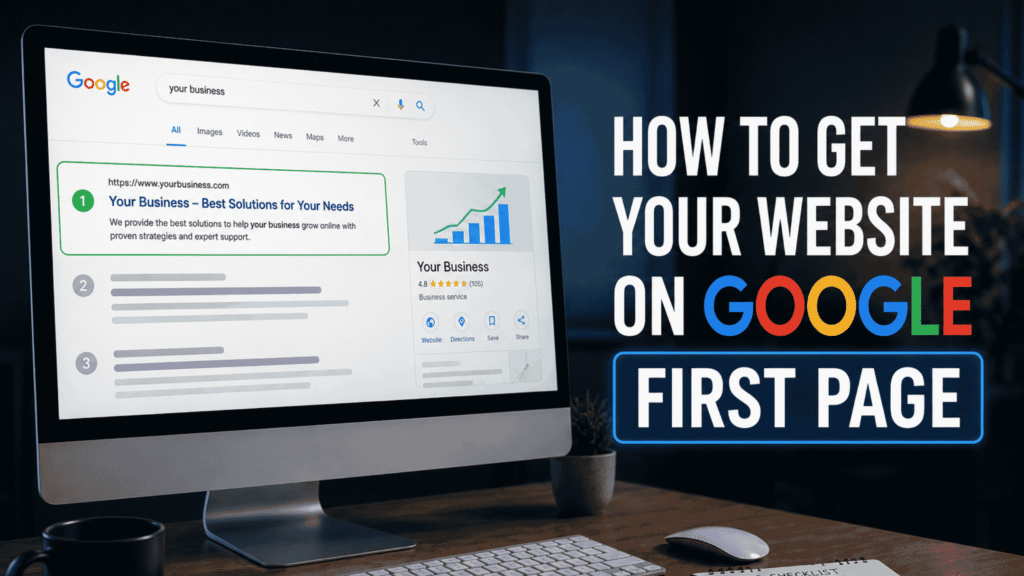
Understanding how to get your website on google first page ultimately comes down to building trust, relevance, and value consistently over time.
The Real Truth About Ranking on Google
The internet is filled with promises about instant rankings, overnight traffic, and guaranteed SEO success. In reality, sustainable growth usually comes from strategic execution, technical improvements, authoritative content, and patience.
Businesses that succeed in search are typically the ones that focus on helping users first instead of trying to manipulate algorithms. Google’s systems continue evolving toward rewarding expertise, usefulness, and authentic value.
If you genuinely want to understand how to get your website on google first page, the answer is not hidden in shortcuts. It comes from creating a website that users trust, search engines understand, and competitors struggle to outperform.