


A growing number of businesses are facing the same frustrating issue. Their website content is detailed, their pages are indexed, and their keyword targeting appears correct, yet rankings continue to decline after Google’s AI-driven search updates. In many cases, the problem is not content quality alone. Slow-loading pages, unstable layouts, and poor mobile usability are now reducing visibility even when the information itself is useful.
This shift has made the core web vitals ranking factor more important than many businesses expected. Google’s AI-powered search experience is increasingly focused on delivering fast, seamless, and trustworthy results to users. If a website struggles to load properly or creates a frustrating experience, AI systems may view the content as less reliable, even if the information is technically accurate.
How Google AI Search Changed Ranking Priorities
Google’s AI search evolution has changed how websites are evaluated. Traditional ranking signals such as backlinks and keyword placement still matter, but user experience signals now influence how AI systems interpret overall page quality.
The latest updates are designed to understand whether a page genuinely satisfies user intent. AI systems analyze how users interact with a website after clicking a result. If visitors leave quickly because a page is slow or unstable, Google may interpret that as a poor experience.
This is why technical performance is no longer just a developer concern. It has become directly connected to search visibility, engagement, and conversion performance.
Many businesses searching for a reliable SEO company near me are now discovering that rankings are increasingly tied to website performance rather than content volume alone.
Understanding What Core Web Vitals Actually Measure
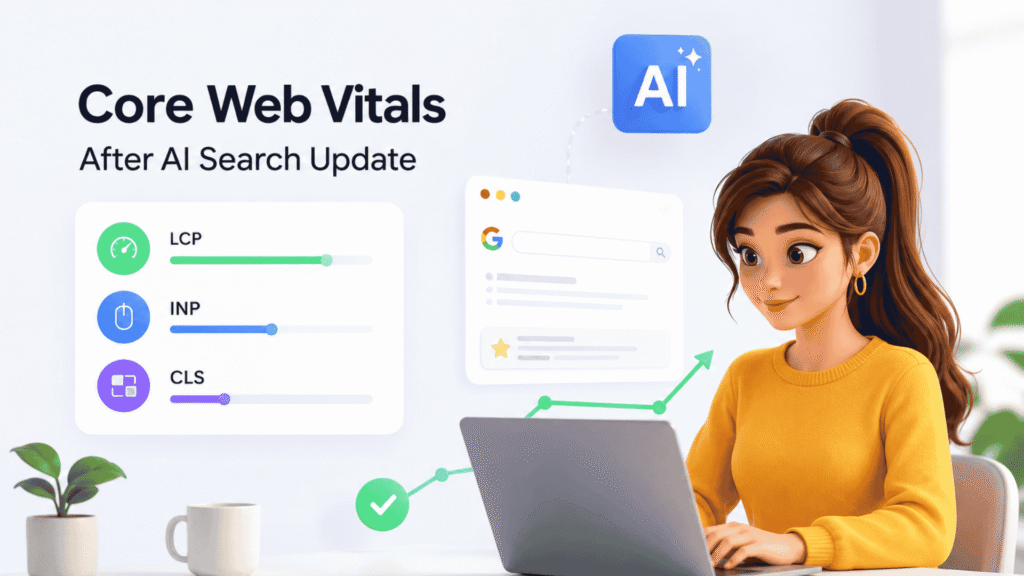
Core Web Vitals are performance metrics created by Google Search Central to evaluate real-world user experience. These metrics focus on three key areas:
Largest Contentful Paint (LCP)
This measures how quickly the main content of a page becomes visible. Users expect important content to load within a few seconds. Slow server response times, oversized images, and unoptimized scripts often delay LCP performance.
Interaction to Next Paint (INP)
INP measures responsiveness. It evaluates how quickly a page reacts when users click, tap, or interact with elements. Heavy JavaScript and excessive third-party tools can create frustrating delays.
Cumulative Layout Shift (CLS)
CLS measures visual stability. Users become frustrated when buttons move unexpectedly or page elements shift during loading. Poor ad placement and missing image dimensions commonly cause this issue.
Together, these signals help Google determine whether users are receiving a smooth and reliable browsing experience.
Why AI Search Systems Care More About Website Experience
AI search systems are designed to deliver answers quickly and efficiently. Google’s AI models aim to recommend pages that users can trust immediately without friction or delays.
When a page loads slowly or behaves unpredictably, users often return to search results within seconds. AI systems interpret these patterns as dissatisfaction signals. Over time, this can reduce visibility even if the content itself remains valuable.
This is one reason many businesses investing in SEO are shifting focus toward technical optimization alongside content strategy.
The impact is especially noticeable on mobile devices, where users expect instant access to information. AI-driven ranking systems increasingly prioritize pages that deliver both relevance and usability.
The Connection Between Core Web Vitals and EEAT
Google’s EEAT principles focus on Experience, Expertise, Authoritativeness, and Trustworthiness. While Core Web Vitals are not direct EEAT signals, they strongly influence how users perceive trust and quality.
For example, if a healthcare or financial website loads slowly, displays unstable layouts, or interrupts content with intrusive elements, users may question the credibility of the information itself.
A technically stable website supports trust. Faster loading speeds improve engagement, reduce bounce rates, and encourage deeper interaction with content. These behavioral improvements align closely with what AI systems attempt to reward.
Businesses investing in AI SEO strategies are increasingly combining content quality with performance optimization because AI systems evaluate the entire user journey rather than isolated ranking factors.
Real Problems Businesses Are Facing After AI Updates
Many websites affected by recent AI search updates are experiencing practical issues that go beyond rankings alone.
Some businesses report declining lead generation despite maintaining strong keyword positions. Others notice reduced engagement because users abandon slow pages before reading the content.
Several common technical problems continue to appear repeatedly:
- Uncompressed images slowing mobile performance
- Excessive plugins increasing page weight
- Poor hosting environments creating server delays
- Unoptimized JavaScript blocking user interaction
- Layout shifts caused by dynamic advertisements
- Heavy popups interrupting page usability
These problems directly affect user behavior, which in turn influences how AI systems evaluate website quality.
For businesses using local seo service Birmingham strategies, performance issues can become even more damaging because local users often expect immediate access to information while searching on mobile devices.
Why Content Alone Is No Longer Enough
For years, many websites relied heavily on publishing large amounts of keyword-focused content. While informative content remains essential, Google’s AI systems are now better at identifying whether users genuinely benefit from the entire browsing experience.
A detailed article may still struggle to perform if users encounter:
- Delayed loading times
- Difficult mobile navigation
- Broken interactive elements
- Distracting visual movement
- Poor accessibility
This is why businesses seeking seo consulting services Birmingham are increasingly prioritizing technical audits alongside content planning.
The future of search visibility depends on balancing information quality with usability and performance.
How Core Web Vitals Affect Local Search Visibility
Local businesses often overlook technical optimization because they focus primarily on map rankings and reviews. However, Google’s AI systems still evaluate page experience when determining local visibility.
If two businesses provide similar services, the faster and more stable website may gain an advantage because users interact more positively with the experience.
This is especially important for companies targeting searches like seo services near me where mobile speed and usability directly influence conversions.
Page experience now affects not only rankings but also customer trust, engagement, and enquiry generation.
Practical Ways to Improve Core Web Vitals
Improving Core Web Vitals requires a combination of technical and strategic adjustments. The most effective improvements often include:
- Compressing and properly sizing images
- Reducing unnecessary plugins and scripts
- Using faster hosting infrastructure
- Implementing lazy loading for media files
- Minimizing render-blocking resources
- Reserving layout space for ads and images
- Improving mobile responsiveness
Regular testing through tools like PageSpeed Insights can help identify performance bottlenecks before they affect rankings further.
Many experienced Birmingham seo experts now treat technical optimization as an ongoing process rather than a one-time fix because Google’s AI systems continuously evolve.
Why the Future of Search Depends on Performance
Google’s AI search updates are pushing websites toward a more user-focused internet experience. Search engines no longer evaluate pages based solely on keywords and backlinks. They increasingly measure how effectively a website serves real users under real conditions.
The businesses that adapt fastest are usually the ones that combine valuable information with strong technical performance, mobile usability, and user trust signals.
As AI systems continue advancing, the core web vitals ranking factor will likely become even more influential because page experience directly impacts how users engage with content. Websites that ignore performance optimization may continue losing visibility, while businesses that improve usability and technical stability are more likely to build long-term search growth through stronger trust, engagement, and search satisfaction.