

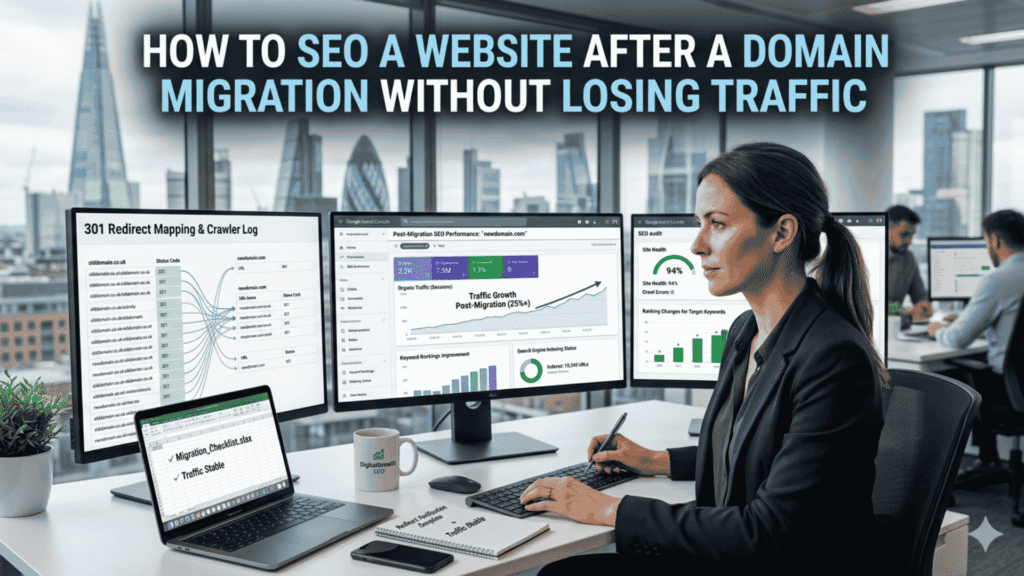
Website owners often discover a serious problem after migrating to a new domain: rankings disappear, organic traffic drops, and previously high-performing pages become difficult to find in search results. What seemed like a simple domain change suddenly turns into months of recovery work. Understanding how to seo a website after a domain migration is critical because even small technical mistakes can lead to significant visibility losses in search engines.
Why Domain Migrations Often Cause Traffic Loss
A domain migration changes the address where search engines and users access your website. While the content may remain unchanged, search engines must reassess the relationship between the old and new domains.
When migrations are handled incorrectly, search engines can encounter issues such as:
- Broken redirects
- Missing pages
- Duplicate content signals
- Lost internal linking structures
- Crawl inefficiencies
- Indexing delays
These problems reduce trust signals and often cause rankings to fluctuate or decline. The good news is that most migration-related traffic losses are preventable with proper planning and execution.
Start With a Complete Website Audit Before Migration
One of the biggest mistakes businesses make is migrating a website without first documenting its current performance.
Before moving to a new domain, collect data on:
- Top-performing pages
- Organic traffic sources
- Ranking keywords
- Backlink profiles
- Indexed URLs
- Technical SEO health
Create a full URL inventory and export all important pages. This inventory becomes the foundation for redirect mapping and performance tracking after migration.
A migration should never begin until you understand what currently drives traffic and conversions.
Create a Precise Redirect Strategy
Redirects are the most important component of a successful migration.
Every old URL should point directly to its most relevant counterpart on the new domain. Avoid redirecting multiple pages to the homepage because this creates poor user experience and weakens relevance signals.
Best practices include:
- Use permanent 301 redirects
- Maintain page-level relevance
- Eliminate redirect chains
- Test all redirects before launch
- Keep redirects active long-term
Search engines use redirects to transfer authority and understand where content has moved. Accurate redirect implementation significantly reduces ranking volatility.
Preserve Existing Site Structure Where Possible
Many businesses combine a redesign with a domain migration. While this may seem efficient, it introduces additional risks.
Search engines already need to process the domain change. Simultaneously changing URLs, navigation, content, and page architecture can create unnecessary confusion.
For better stability:
- Keep major URL structures intact
- Maintain category hierarchies
- Preserve internal linking patterns
- Avoid removing valuable content
Making too many changes at once makes it difficult to identify the cause of traffic fluctuations.
Update Internal Links and Technical Signals
After migration, every internal signal should reinforce the new domain.
Review and update:
- Navigation links
- Footer links
- Canonical tags
- XML sitemaps
- Structured data references
- Image URLs
- Hreflang tags
- Open Graph tags
Many migrations fail because websites continue referencing old URLs internally. Search engines interpret these mixed signals as inconsistencies, which can slow the transfer of ranking authority.
This stage is where businesses often discover the practical reality of how to seo a website during a migration: technical accuracy matters more than shortcuts.
Notify Search Engines Properly
Once the new domain is live, search engines need clear communication.
Actions to complete include:
- Verify the new domain in Search Console
- Submit updated XML sitemaps
- Request indexing of priority pages
- Monitor crawl errors
- Check coverage reports regularly
Search engines eventually discover changes on their own, but proactive submission accelerates recognition and indexing.
Monitoring during the first several weeks is especially important because crawl anomalies often appear after launch.
Protect Backlink Equity
Backlinks remain one of the strongest ranking signals.
Although 301 redirects pass significant authority, updating important backlinks directly is still beneficial.
Identify high-value referring domains and request updates where possible. Prioritize:
- Business directories
- Industry websites
- Resource pages
- Partnership websites
- Media mentions
For businesses operating in competitive sectors such as those offering a real estate seo service, preserving backlink equity can be the difference between maintaining rankings and experiencing substantial visibility losses.
Monitor Performance Daily During the Recovery Phase
Traffic fluctuations immediately after migration are normal.
However, successful migrations are measured through data rather than assumptions.
Track:
- Organic sessions
- Keyword rankings
- Crawl activity
- Indexed pages
- Conversion metrics
- Page performance
Compare post-migration data against your pre-migration benchmarks.
Minor volatility is expected, but significant traffic declines usually indicate technical issues requiring investigation.
Strengthen Local and Brand Signals
For businesses targeting regional audiences, domain migrations can temporarily affect local visibility.
Ensure consistency across:
- Business profiles
- Citations
- Local directories
- Social media accounts
- Review platforms
Organizations investing in Local SEO should verify that all location references reflect the new domain.
Similarly, companies operating in competitive markets such as AI SEO Birmingham should closely monitor local rankings during the transition period to identify changes quickly.
Evaluate User Experience After Migration
SEO performance is closely tied to user behavior.
After launch, review:
- Mobile usability
- Core Web Vitals
- Navigation flow
- Page loading speed
- Conversion paths
A technically successful migration can still lose traffic if user experience deteriorates.
Search engines increasingly evaluate real user interactions, making performance optimization an essential post-migration activity.
Common Migration Mistakes to Avoid
Many ranking losses stem from avoidable errors.
The most common mistakes include:
- Launching without redirect testing
- Blocking search engine crawlers accidentally
- Removing valuable pages
- Forgetting canonical updates
- Ignoring crawl errors
- Migrating during peak business periods
- Failing to monitor rankings
Businesses frequently searching for terms such as seo contractors near me, freelance seo specialists near me, or seo marketing company near me often seek expert assistance because these technical details can become overwhelming during complex migrations.
Final Thoughts
A domain migration does not have to result in lost rankings or reduced organic visibility. Success depends on preparation, technical accuracy, continuous monitoring, and a structured migration process. By implementing proper redirects, preserving authority signals, updating technical elements, and following proven SEO best practices, businesses can transfer their search performance effectively. As search engines continue evolving and integrating technologies associated with AI SEO, understanding how to seo a website after a domain migration remains one of the most valuable skills for protecting long-term organic growth.