

Most business websites do not struggle because of poor design alone. The real issue is that their content lacks structure, depth, and topical relevance. A website may publish dozens of pages, but if Google cannot understand the expertise behind those pages, rankings stay inconsistent. This is one of the biggest reasons businesses fail when trying to learn how to get your website to the top of google.
Many companies publish random blogs targeting isolated keywords without building a connected content ecosystem. As search algorithms evolve, Google increasingly rewards websites that demonstrate authority around an entire topic rather than a single page. This is where topical authority and content clusters become essential.
Whether you run an ecommerce store, local business website, or service-based platform, understanding how to structure content strategically can significantly improve visibility, organic traffic, and qualified enquiries.
Why Most Websites Fail to Rank Consistently
A common mistake businesses make is focusing only on high-volume keywords. They create one optimized page, add a few backlinks, and expect rankings to grow. In reality, Google evaluates overall expertise, content relationships, user intent satisfaction, and website depth.
For example, a website offering digital marketing services may only create one page targeting SEO-related terms. Meanwhile, competitors publish interconnected content about technical optimization, content strategy, local search, entity signals, indexing, user behavior, and search intent.
Google naturally trusts the website that demonstrates broader expertise.
This shift is especially noticeable after recent algorithm updates that prioritize helpful content and topic relevance over keyword repetition.
What Is Topical Authority?
Topical authority refers to how strongly Google associates your website with expertise in a specific subject area. Instead of ranking because of one page, your website ranks because your entire content ecosystem proves credibility.
Think of it like this:
- A single article answers one question.
- A topical authority website answers every important question related to the subject.
Google wants to recommend websites that provide complete solutions rather than partial information.
For instance, if you operate a website about digital marketing, publishing only one guide on rankings is not enough. You need supporting content around keyword research, technical optimization, content planning, search intent, internal linking, local visibility, AI-driven search changes, and user engagement.
This layered approach creates strong semantic relationships between pages.
Understanding Content Clusters
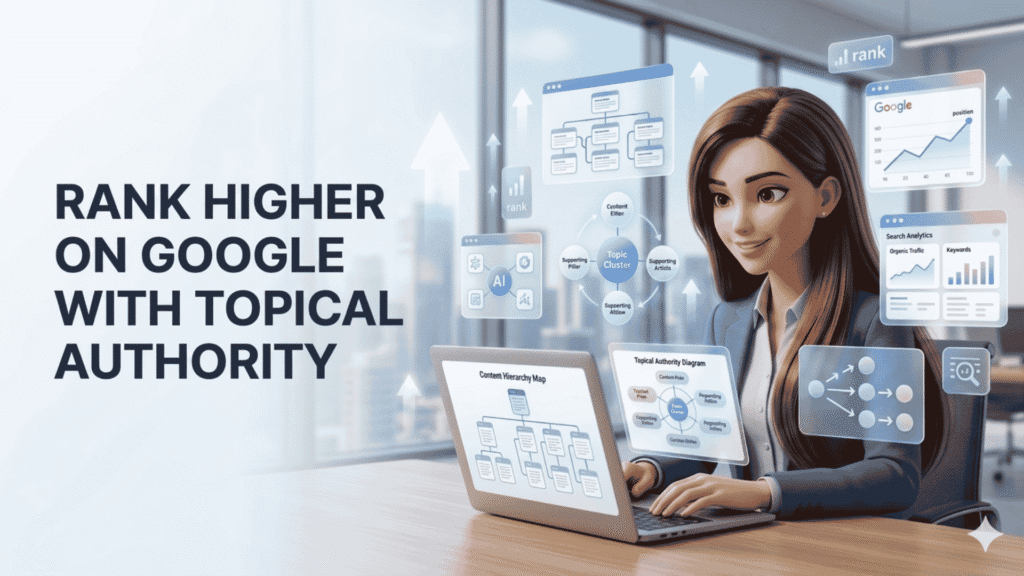
Content clusters are structured groups of related pages connected to a central “pillar” topic.
The structure usually looks like this:
Pillar Page
A broad, comprehensive guide covering the main topic.
Cluster Pages
Supporting articles that explore specific subtopics in depth.
Internal Linking System
All supporting pages connect back to the pillar page and to each other where relevant.
This system helps search engines understand your website architecture and topical relevance.
How Content Clusters Improve Rankings
Content clusters improve visibility because they help Google:
- Understand subject expertise
- Discover related pages faster
- Interpret semantic relationships
- Improve crawl efficiency
- Measure user engagement signals
- Identify comprehensive coverage
They also improve user experience because visitors can easily navigate related topics without returning to search results.
Lower bounce rates and higher session durations often follow naturally when cluster structures are implemented correctly.
Building a Topical Authority Strategy Step by Step
1. Start With One Core Topic
Choose a topic closely related to your services or business goals.
Examples include:
- Technical optimization
- Ecommerce growth
- Local business visibility
- Content marketing
- Website performance
Avoid covering too many unrelated topics at the beginning. Focus creates stronger authority signals.
2. Create a Pillar Page
Your pillar page should comprehensively explain the main subject.
It should include:
- Definitions
- Common problems
- Processes
- Best practices
- Strategies
- Frequently asked questions
- Supporting subtopics
The goal is not keyword stuffing. The goal is depth and usefulness.
A properly structured pillar page often becomes the foundation for long-term organic growth.
3. Identify Supporting Cluster Topics
Supporting pages should answer highly specific questions users search for.
For example, a pillar page about search visibility may include cluster topics like:
- Internal linking strategies
- Crawl budget optimization
- Schema implementation
- Search intent mapping
- User experience signals
- Content decay management
Each cluster page should deeply solve one problem.
4. Use Strategic Internal Linking
Internal linking is one of the most overlooked ranking factors.
Many websites publish articles but fail to connect them logically. Without contextual linking, search engines struggle to understand content relationships.
Effective internal links should:
- Connect related concepts naturally
- Support user navigation
- Pass contextual relevance
- Reinforce topic relationships
Avoid excessive linking solely for optimization purposes.
The Role of Search Intent in Topical Authority
Google prioritizes pages that satisfy user intent completely.
Before creating any page, determine whether the searcher wants:
- Information
- Comparisons
- Solutions
- Local providers
- Product recommendations
- Step-by-step guidance
Content clusters work best when every stage of user intent is covered comprehensively.
This is why businesses investing in structured content strategies often outperform websites producing isolated articles.
Why Thin Content No Longer Works
Short, repetitive content written only around keywords rarely performs well today.
Google’s systems evaluate:
- Originality
- Experience
- Depth
- Topic relationships
- User engagement
- Helpfulness
Many websites affected by ranking drops still rely on outdated publishing methods focused entirely on keyword density.
Modern ranking growth depends more on expertise and topical completeness.
How AI Is Changing Search Visibility
Search engines increasingly rely on entity understanding, semantic analysis, and predictive relevance systems.
This means content quality alone is no longer enough. Websites also need strong structure, context, and relationship mapping between pages.
This is where AI SEO strategies are becoming more important. Businesses now optimize not only for keywords but also for entities, contextual signals, and topic relationships that machine learning systems can interpret effectively.
Websites that adapt to this shift are more likely to maintain long-term rankings as search evolves.
The Importance of Geographic Relevance
For service-based businesses, topical authority should also include location relevance.
A website targeting local customers needs content connected to geographic intent, service areas, and local search behavior.
This is why Local SEO remains critical for businesses that depend on nearby customers rather than national traffic.
For example, a service provider building authority around regional search topics can improve visibility for highly converting local searches.
Common Mistakes Businesses Make
Publishing Random Blogs
Unrelated content weakens topical focus and confuses search engines.
Ignoring Internal Links
Disconnected pages reduce semantic strength.
Targeting Too Many Keywords Per Page
Pages become unfocused and fail to satisfy search intent.
Creating Surface-Level Content
Thin articles rarely build trust or authority.
Copying Competitor Structures
Many businesses imitate rankings without understanding why those pages perform well.
Measuring Topical Authority Growth
You can track progress through:
- Increased keyword visibility
- Higher impressions
- More indexed pages
- Improved crawl frequency
- Longer user engagement
- Growth in long-tail traffic
- Better rankings across related queries
Often, rankings improve gradually across entire topic groups rather than individual pages.
This is one reason structured content systems create more sustainable results than isolated optimization campaigns.
Why Businesses Are Restructuring Their Content Strategies
Many companies previously depended on aggressive link-building and isolated keyword targeting. However, modern search visibility increasingly depends on content ecosystems.
Businesses working with a Birmingham seo company or an experienced seo consultant birmingham often discover that rankings improve faster when content architecture is rebuilt around topical authority instead of disconnected pages.
Similarly, a growing number of brands now prioritize entity optimization, semantic coverage, and structured information frameworks rather than outdated keyword-heavy strategies.
Building Long-Term Search Visibility
Sustainable rankings come from consistency, structure, and expertise.
A website that continuously expands useful content around core topics becomes easier for Google to trust over time.
Whether you work with a SEO Agency in Birmingham, hire a Birmingham SEO expert, or manage campaigns internally, the core principle remains the same:
Search engines reward websites that fully solve user problems.
That is why businesses investing in structured SEO strategies, semantic content systems, and topical authority frameworks often achieve stronger long-term growth than websites focused only on isolated keywords.
Understanding how to get your website to the top of google is no longer about publishing more pages. It is about building a connected knowledge ecosystem that demonstrates expertise, trust, and relevance across an entire subject area.