


Why So Many Businesses Struggle to Track Their Real Google Rankings
A common frustration many business owners and marketers face is seeing different keyword positions across multiple SEO tools. One platform shows a keyword ranking in the top 5, while another reports it outside the first page. This confusion becomes even more frustrating when traffic does not match the reported positions.
The problem usually starts when businesses rely on ranking numbers without understanding how tracking systems actually work. Search results change based on location, device, personalization, user behavior, and search intent. Because of this, many companies end up making decisions using incomplete data.
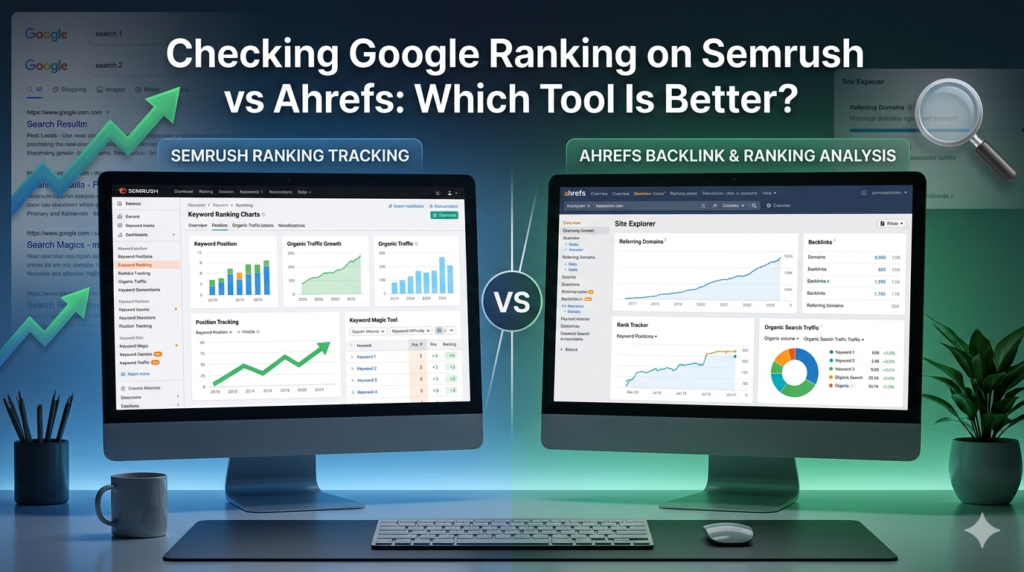
When it comes to checking google ranking, two tools dominate the conversation: Semrush and Ahrefs. Both platforms are powerful, widely used, and trusted across the SEO industry. However, they approach ranking data differently, and understanding those differences can help businesses avoid inaccurate reporting, wasted SEO efforts, and poor strategy decisions.
Why Accurate Rank Tracking Matters More Than Ever
Google’s search ecosystem is no longer simple. Search results now include AI summaries, local packs, featured snippets, shopping results, videos, map listings, and people-also-ask sections. This means traditional keyword rankings alone no longer tell the full story.
Businesses that depend on organic visibility need accurate tracking because rankings influence traffic forecasting, lead generation, and conversion strategy. An inaccurate keyword position can lead teams to optimize the wrong pages or ignore opportunities that are already generating visibility.
This is especially important for companies investing in SEO campaigns across multiple regions and devices. A business targeting national search terms may experience completely different results from users searching locally. That is why many agencies and consultants now combine traditional SEO analysis with AI SEO workflows to better understand search behavior patterns and content performance.
Understanding How Semrush Tracks Rankings
Semrush focuses heavily on visibility tracking and competitive keyword movement. Its Position Tracking tool allows users to monitor keyword changes daily across desktop and mobile devices.
One of Semrush’s strongest features is its ability to segment ranking data by location. Businesses can monitor keyword positions at country, city, or ZIP-code level, making it useful for regional campaigns.
Semrush also provides:
- Visibility percentage tracking
- SERP feature monitoring
- Estimated traffic changes
- Competitor comparison reports
- Keyword cannibalization insights
- Daily ranking updates
For businesses managing multiple service areas, Semrush often performs better when local intent matters. For example, a company targeting searches like local seo expert near me may need highly localized ranking reports to understand how users see results in specific regions.
Another practical advantage is Semrush’s visual reporting dashboard. Agencies handling client campaigns often prefer its reporting system because it simplifies keyword trend analysis for non-technical stakeholders.
However, Semrush ranking volatility can sometimes appear aggressive because the tool updates visibility shifts quickly. This may create temporary fluctuations that confuse businesses unfamiliar with how search volatility works.
How Ahrefs Handles Keyword Rank Tracking
Ahrefs approaches ranking analysis differently. While it offers keyword tracking features similar to Semrush, its biggest strength lies in backlink intelligence and organic keyword discovery.
Ahrefs is widely respected for its crawler database and link analysis accuracy. Because backlinks still influence authority and ranking stability, many SEO professionals trust Ahrefs when evaluating long-term organic growth.
Its rank tracker focuses more on:
- Organic keyword position trends
- Share of voice analysis
- Historical ranking comparisons
- Competitor overlap
- Keyword movement visualization
- Search intent grouping
Ahrefs also tends to present cleaner keyword movement history over longer periods. This makes it useful for businesses analyzing gradual ranking improvements instead of short-term fluctuations.
One major difference is how Ahrefs estimates traffic. Its calculations are often more conservative compared to Semrush. In practical campaigns, this can sometimes create a more realistic understanding of organic performance.
Businesses working with technical optimization strategies or link-building campaigns often prefer Ahrefs because ranking analysis integrates naturally with backlink evaluation.
Semrush vs Ahrefs: Which Tool Gives More Accurate Rankings?
There is no universal winner because ranking accuracy depends on what you are trying to measure.
Semrush generally performs better for:
- Localized keyword tracking
- Daily visibility monitoring
- SERP feature analysis
- Agency reporting
- Competitor visibility comparisons
Ahrefs often performs better for:
- Long-term keyword analysis
- Backlink-driven SEO campaigns
- Organic growth research
- Historical ranking evaluation
- Content gap analysis
In real-world SEO campaigns, many professionals use both tools together because each platform reveals different insights.
For example, a business investing in website seo birmingham may use Semrush to monitor localized ranking fluctuations while using Ahrefs to analyze competitor backlinks and authority growth.
Similarly, companies targeting competitive regional markets may combine ranking tools with detailed search intent analysis to improve page relevance rather than focusing only on keyword positions.
Why Rankings Often Look Different Between Tools
Many business owners assume one tool is incorrect when rankings differ. In reality, ranking discrepancies usually happen because:
Data Collection Methods Differ
Each tool uses separate crawlers, databases, and update frequencies. Rankings may be captured at different times of day, which affects visibility.
Location Tracking Is Different
Search results vary heavily by geography. A keyword ranking in Birmingham may display differently in London, Manchester, or nearby suburbs.
Search Personalization Affects Results
Google customizes search results based on device history, user behavior, and intent signals.
SERP Features Change Visibility
Even if a page ranks highly, map packs, AI overviews, and snippets can reduce actual clicks.
Keyword Matching Varies
Some tools group keyword variations differently, creating inconsistencies in reported positions.
Understanding these differences prevents businesses from making reactive decisions based solely on ranking movements.
Which Tool Is Better for Local SEO Campaigns?
Businesses targeting location-specific traffic usually require deeper regional tracking capabilities. In this area, Semrush often provides a stronger experience because of its advanced local position tracking.
For companies operating in competitive service regions, Local SEO performance depends heavily on proximity signals, Google Business Profile optimization, and local search intent.
A business searching for seo support birmingham strategies, for example, may need visibility tracking at neighborhood level rather than national keyword averages.
However, Ahrefs still remains valuable because local campaigns also depend on authority-building, backlinks, and content trust signals.
The Hidden Problem With Focusing Only on Rankings
Many businesses become obsessed with ranking positions while ignoring conversion quality.
A keyword reaching position three does not automatically increase revenue if the page fails to satisfy user intent. Modern SEO requires understanding:
- Why users search
- What content solves their problem
- Which pages generate engagement
- How visitors interact with content
- Whether traffic converts into leads or sales
This is why successful SEO campaigns combine rankings with behavioral metrics, user experience analysis, and content optimization.
Businesses working with a seo company west midlands often discover that improving content quality and search intent alignment creates stronger long-term growth than chasing temporary ranking spikes.
Practical Recommendation: Which Tool Should You Choose?
The better tool depends on your business goals.
Choose Semrush if your focus is:
- Local visibility tracking
- Daily rank monitoring
- Client reporting
- Regional campaigns
- SERP feature analysis
Choose Ahrefs if your focus is:
- Link-building strategy
- Authority growth
- Historical ranking analysis
- Competitor backlink research
- Long-term organic trends
For many growing businesses, the ideal approach is combining both platforms strategically.
A company working with seo firms near me may use Semrush for daily reporting while relying on Ahrefs for competitor research and backlink analysis.
Final Thoughts
The reality is that no SEO tool can perfectly replicate live Google search results for every user at every moment. Search rankings constantly shift based on personalization, location, intent, and SERP changes.
The goal of checking google ranking should not be chasing vanity metrics. Instead, businesses should focus on understanding visibility trends, user behavior, and search intent patterns that influence actual traffic and conversions.
Semrush offers stronger local tracking and reporting capabilities, while Ahrefs provides exceptional backlink intelligence and long-term organic analysis. Choosing the right platform depends on your campaign goals, reporting needs, and optimization strategy.
Businesses that combine technical SEO, content relevance, authority building, and realistic ranking analysis usually achieve more stable growth than those relying only on keyword position numbers.
As search continues evolving with AI-driven experiences and changing user behavior, successful SEO strategies will increasingly depend on data interpretation rather than simply tracking rankings alone.