



Search used to begin with a keyboard.
Someone had a question, typed a few words into Google, scanned a list of blue links, and clicked the result that looked most relevant. SEO evolved around that behaviour: keywords, headings, backlinks, metadata, internal linking and written content became the core ingredients of search visibility.
That model is changing.
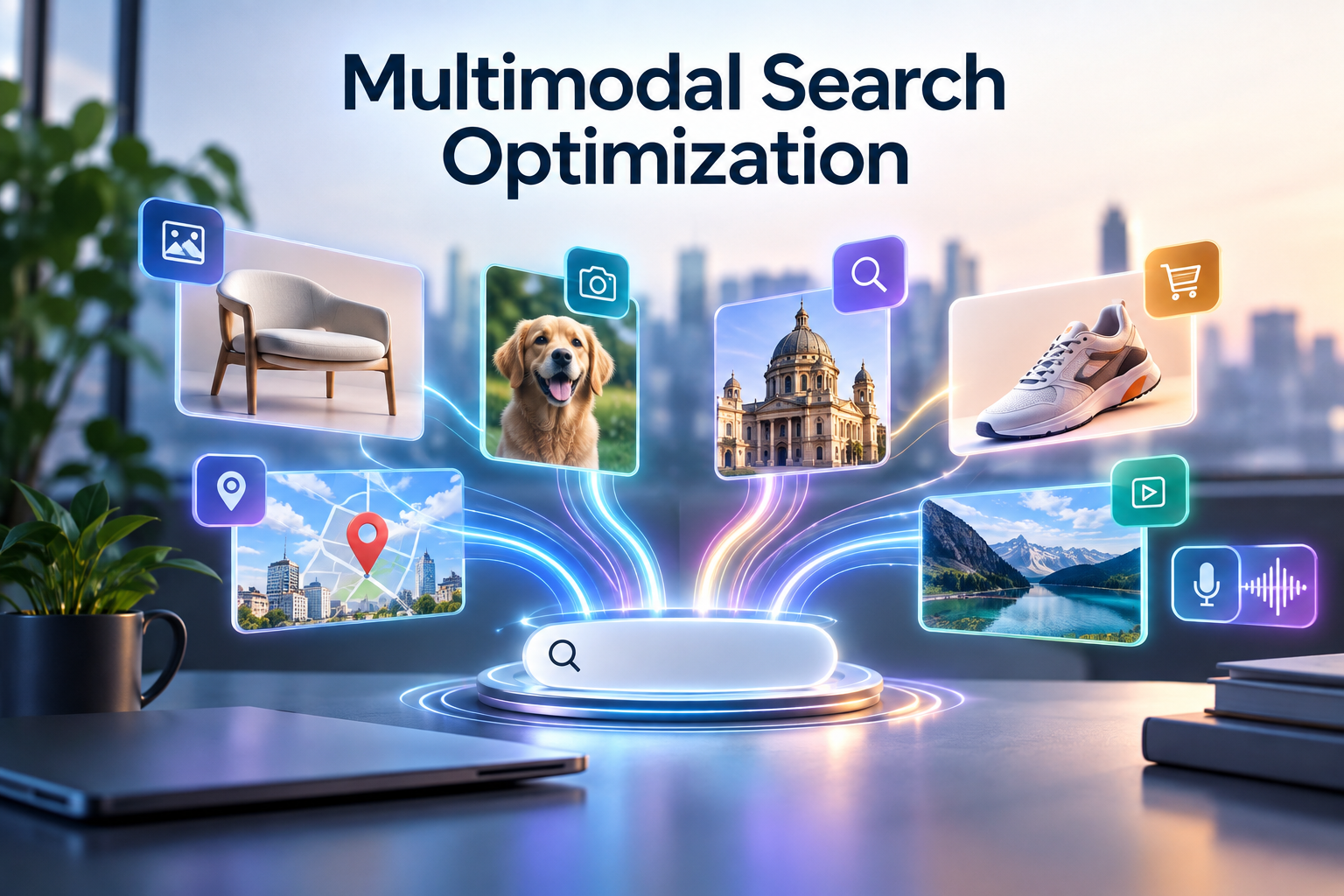
People can now search by uploading an image, pointing a camera at an object, asking a spoken question, submitting a screenshot or combining visual information with text. Google’s AI-powered search experiences are increasingly designed to understand several forms of information at once. Google says Lens is used by more than 1.5 billion people every month, while its newer AI Mode experiences can analyse images, identify multiple objects and perform related searches in the background.
That creates a fundamental SEO problem: a website can be highly optimized for words while remaining poorly optimized for everything else search engines can now understand.
What Is Multimodal Search?
Multimodal search allows people to interact with search using more than traditional typed text. The input might be an image, voice, video, screenshot, document or a combination of several formats.
Consider a simple example.
Someone sees a pair of shoes they like but doesn’t know the brand. Instead of describing the shoes using ten different keywords, they take a picture and ask, “Where can I find something like this?”
The search engine has to understand the image, identify relevant characteristics, interpret the question and connect those signals with useful results.
The same principle applies to local businesses.
A person could photograph a damaged roof, upload the image and ask what type of repair might be required. Someone could photograph a restaurant menu and ask whether it contains vegetarian options. A homeowner could show a picture of a bathroom and ask for renovation ideas.
The query is no longer simply a string of keywords. It is a combination of visual context, language, intent and entities.
Google has already expanded visual search so AI Mode can understand multiple objects within an image and generate several related searches from a single visual input.
Why Text-Only SEO Has a Growing Blind Spot
Traditional SEO is still important. Text remains one of the clearest ways to explain expertise, answer questions and establish topical relevance.
The problem is relying on text alone.
Imagine a furniture company publishes a 2,000-word article about a modern oak dining table. The article contains excellent information about dimensions, materials, maintenance and styling.
But the images are named IMG_4837.jpg.
The alt text simply says “table.”
There is no descriptive caption. Product information isn’t clearly connected to the image. There is no structured information explaining what the object represents.
A human visitor may understand the photograph immediately.
A search system has fewer explicit signals connecting that visual asset to the company’s product, category and subject matter.
This is where the next stage of SEO becomes important.
The New Relationship Between Images and Search
Images are no longer just decorative elements placed between paragraphs.
They can become search entry points.
Google’s own research around Lens highlights the importance of having strong product imagery together with accurate and specific metadata.
For businesses, this means every important image should have a clear purpose.
A product photograph should communicate what the product is.
A service photograph should make the service understandable.
A location image should reinforce where the business operates.
An infographic should explain information rather than simply repeat a decorative graphic.
That requires descriptive filenames, useful alt text, relevant surrounding copy, captions where appropriate and structured data when applicable.
The objective isn’t to stuff keywords into every image attribute. It is to remove ambiguity.
If an image shows a black ceramic-coated sports car, the surrounding page should make it obvious whether the image represents ceramic coating, paint correction, vehicle detailing or something else.
Search systems are becoming better at interpreting visual context. Your job is to give them enough reliable information to interpret it correctly.
Voice Search Changes the Meaning of “Keyword”
Multimodal search isn’t limited to photographs.
Voice creates another major shift.
People speak differently from the way they type.
Someone may type:
“roof repair Birmingham”
But ask a voice assistant:
“What should I do if my roof starts leaking during heavy rain?”
The second query contains much more context.
This means content should increasingly answer complete questions rather than targeting isolated keyword variations. FAQ sections, conversational headings, concise explanations and genuinely useful supporting information can help search systems understand the relationship between a question and an answer.
For local businesses, this becomes particularly important because spoken searches often contain location, service and urgency signals.
A page about emergency plumbing, for example, should clearly explain what the service covers, when customers may need it, the areas served and what someone should do before professional help arrives.
That information can serve both humans and search systems.
Video Is Another Searchable Information Layer
Video adds yet another dimension.
A five-minute video can demonstrate a process that would require hundreds of words to describe. It can show a product being installed, a repair being completed, a property being renovated or a professional explaining a complex concept.
But uploading a video isn’t enough.
Search systems need context.
A useful video page should include a descriptive title, supporting text, an accurate description and, where appropriate, a transcript. Important concepts discussed in the video should also be explained on the surrounding page.
Think of the webpage as the central information hub and the video as another way of communicating the same expertise.
This creates stronger connections between written, visual and audiovisual information.
What Multimodal Search Optimization Actually Involves
multimodal search optimization is not about replacing conventional SEO.
It is about expanding the definition of what needs to be optimized.
A strong strategy connects several layers:
Written content: Clear explanations, useful headings, natural language and comprehensive answers.
Images: Original visuals with descriptive filenames, meaningful alt text and contextual relevance.
Video: Useful demonstrations, transcripts, descriptive titles and supporting information.
Structured data: Markup that helps search engines understand entities, products, services, locations and other page elements.
Entities: Consistent information about the business, people, products, services and places represented across the website.
Technical accessibility: Search engines need to be able to crawl, render and access the assets you’re expecting them to understand.
The important idea is consistency.
If your text says one thing, your images imply another and your structured data provides incomplete information, the signals are fragmented.
When these elements reinforce one another, the page becomes easier to interpret.
Local SEO Needs a Multimodal Upgrade Too
Local businesses have a particularly interesting opportunity because local discovery is naturally visual.
Think about the information someone might want before visiting a business:
What does the storefront look like?
What does the finished work look like?
What does the interior look like?
What does the product look like in real-world conditions?
Where exactly is the business?
What does the surrounding area look like?
These questions cannot always be answered effectively with text.
A strong local presence should therefore connect location information with photographs, service pages, customer-focused explanations, reviews, business details and other trustworthy signals.
For a local seo company uk, this also means understanding that local visibility isn’t limited to ranking a Google Business Profile for a handful of keywords. Search behaviour increasingly involves discovering businesses through images, maps, reviews, products and conversational questions.
The same principle applies when developing location-specific pages. A SEO company in Birmingham should not rely solely on inserting a city name into headings. A genuinely useful local page should explain the service, demonstrate expertise, answer local customer questions and provide meaningful evidence of the business’s relevance.
How Businesses Can Start Preparing
The transition doesn’t require rebuilding an entire website overnight.
Start by auditing your existing content.
Look at your most important commercial pages and ask:
Can search engines clearly understand every image?
Are your images original and relevant?
Do important videos have supporting text or transcripts?
Are products, services and locations clearly identified?
Does your structured data accurately describe the page?
Can a person understand the subject of an image without guessing?
Are your written answers useful enough to support conversational searches?
A Birmingham SEO professional reviewing a local business website, for example, could begin with the company’s highest-value service pages rather than attempting to optimize hundreds of URLs simultaneously.
Then expand the approach to blogs, product pages, location pages and visual assets.
The goal is not to create more content simply for the sake of creating more content.
The goal is to make existing content understandable across more search interfaces.
The Future of SEO Is Becoming More Visual
The rise of multimodal search doesn’t mean traditional SEO is disappearing.
Keywords still matter. Technical accessibility still matters. Links still matter. High-quality written content still matters.
What is changing is the number of ways users can express intent.
Google’s recent developments show how visual search is moving beyond simple image matching toward deeper interpretation. AI Mode can analyse an image, identify objects, understand accompanying questions and fan out into multiple searches to construct a richer response.
That changes what it means to create a search-optimized page.
A page shouldn’t simply be written for a crawler that reads words.
It should communicate clearly through text, images, video, structure and context.
For businesses investing in local seo uk, that distinction is increasingly important. The companies prepared for this environment won’t necessarily be the ones producing the most content. They will be the ones making their information easiest for both people and increasingly sophisticated search systems to understand.
Final Takeaway
The biggest mistake is treating multimodal search as another SEO trend that can be addressed later.
Search behaviour is becoming more flexible. People can show Google what they mean instead of explaining it entirely with words. They can speak naturally, upload images, interact with visual results and ask follow-up questions.
That means your website needs to communicate beyond the written paragraph.
Multimodal search optimization provides a framework for doing exactly that: connecting text, images, video, structured data and entities into one coherent information system.
Text-only SEO built the foundation of modern search visibility.
The next challenge is making that foundation understandable to a search environment that can increasingly read, see, hear and reason across different types of information.