


Businesses are under constant pressure to grow faster, reduce costs, and improve customer experiences. Artificial intelligence has become one of the biggest business trends, but many business owners still ask the same question: will AI replace people, or should it simply support them? The reality is much simpler. Companies that understand how to combine technology with skilled employees are creating stronger businesses. Just as businesses invest in seo page rank to improve online visibility, they should also focus on creating the right balance between AI and human talent to build long-term success.
Why Businesses Are Investing in AI
Every growing business reaches a point where manual work starts slowing down operations. Teams spend hours answering common customer questions, updating spreadsheets, creating reports, or following repetitive processes. These tasks consume valuable time without adding much strategic value.
AI helps businesses automate these repetitive activities so employees can focus on work that requires creativity, communication, and decision-making. This is why businesses across industries are adopting AI—not because they want fewer employees, but because they want their teams to become more productive.
When used correctly, AI can help businesses:
- Reduce operational costs
- Respond to customers more quickly
- Improve efficiency
- Handle larger workloads
- Make faster decisions using data
However, none of these benefits mean that people are no longer important.
The Value That Humans Still Bring
Technology can process information at incredible speed, but it cannot replace human understanding, emotions, or experience.
Customers still prefer dealing with people when making important decisions. Business relationships are built on trust, and trust comes from genuine conversations, expert advice, and understanding individual situations.
Employees also bring qualities that AI cannot easily copy, including:
- Creative thinking
- Problem-solving in unexpected situations
- Leadership
- Negotiation skills
- Customer empathy
- Business vision
These are the qualities that help companies stand out in competitive markets.
Businesses that only rely on automation often discover that efficiency improves, but customer satisfaction may not. The strongest businesses combine technology with experienced professionals who know when personal attention matters most.
AI Handles Speed While Humans Handle Strategy
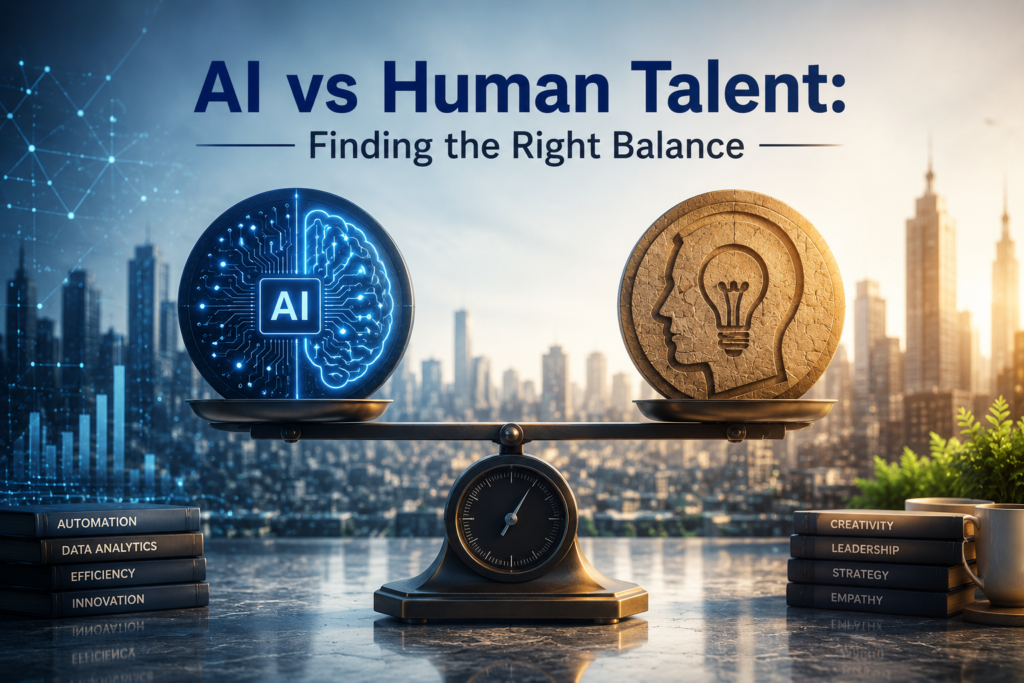
One of the easiest ways to understand the relationship between AI and people is to think of their different strengths.
AI performs best when tasks are repetitive, data-driven, and predictable.
Humans perform best when situations require judgment, innovation, relationship building, and business strategy.
For example, AI can analyse customer behaviour within minutes, but deciding how to launch a new product still depends on experienced business leaders.
AI can organise thousands of customer enquiries, but resolving a frustrated customer’s concerns often requires empathy and communication.
Instead of choosing one over the other, successful companies allow each to do what they do best.
The Most Successful Businesses Are Using Both
Many growing companies have already discovered that AI works best as a business assistant rather than a replacement.
Marketing teams use AI to organise campaign data while professionals create messaging that connects with customers.
Sales teams use AI to identify promising leads while experienced salespeople build trust and close deals.
Customer support teams automate simple enquiries while human agents solve complex problems.
Finance departments automate reporting while managers use the information to make business decisions.
The result is a faster business without losing the personal service customers expect.
This balanced approach also improves employee satisfaction because staff spend less time on repetitive work and more time on meaningful projects.
AI Creates New Opportunities Instead of Removing Them
One common concern is that AI will eliminate jobs. While some repetitive tasks may become automated, history shows that technology usually changes jobs rather than removing them completely.
Businesses now need employees who can:
- Work alongside AI tools
- Analyse business insights
- Manage customer relationships
- Develop creative solutions
- Improve business processes
New opportunities continue to appear as businesses adopt smarter systems.
Companies that invest in employee training alongside AI adoption often see better results because their teams learn how to use technology as a productivity tool rather than viewing it as competition.
Finding the Right Balance for Business Growth
Every business is different, so there is no single formula for using AI successfully.
Instead of trying to automate everything, business owners should first identify the areas where automation delivers the greatest value.
Questions worth asking include:
- Which daily tasks consume the most employee time?
- Which activities are repetitive?
- Where do customers expect faster responses?
- Which decisions still require human expertise?
The answers usually reveal where AI can improve efficiency without reducing the importance of experienced employees.
Businesses that grow steadily focus on improving processes instead of replacing people.
Building Stronger Customer Experiences
Customers rarely remember how quickly a computer completed a task.
They remember how a business made them feel.
AI can certainly improve response times, organise information, and personalise recommendations. However, customers still appreciate speaking with knowledgeable professionals who understand their needs and provide practical advice.
Businesses that combine faster service with genuine human interaction often build stronger customer loyalty.
This is especially important for industries where trust influences purchasing decisions, including healthcare, finance, legal services, education, and professional consulting.
Technology supports these relationships, but people continue to strengthen them.
The Future Belongs to Businesses That Adapt
The business world is changing quickly, and companies that ignore AI may struggle to remain competitive. At the same time, businesses that depend entirely on automation may lose the personal connections that help them grow.
The future belongs to organisations that understand how technology and people complement each other.
Rather than asking whether AI or humans are better, business owners should focus on how both can work together to create better outcomes.
This mindset allows companies to improve productivity while continuing to deliver outstanding customer experiences.
AI and Business Growth Also Depend on Online Visibility
Technology is changing how customers discover businesses online as well. AI-powered search experiences, smarter search engines, and changing customer behaviour mean companies need to improve both their digital presence and customer experience.
Businesses investing in SEO, AI SEO, and Local SEO are positioning themselves to reach customers more effectively while adapting to future search trends. Many organisations also work with an Expert digital marketing partner to ensure their online strategy evolves alongside changing technology.
Whether you’re searching for a seo company in Birmingham United Kingdom, a seo company birmingham city centre, or a Birmingham city centre seo company, the goal should always be the same: combining smart technology with experienced professionals who understand real business growth.
Conclusion
AI is transforming businesses, but people remain the driving force behind innovation, leadership, customer relationships, and long-term success. Companies that achieve the right balance between automation and human expertise are better positioned to improve efficiency without losing the personal touch that customers value. Just as improving seo page rank requires consistent strategy rather than shortcuts, sustainable business growth comes from combining the strengths of AI with the experience and judgment of talented people.