

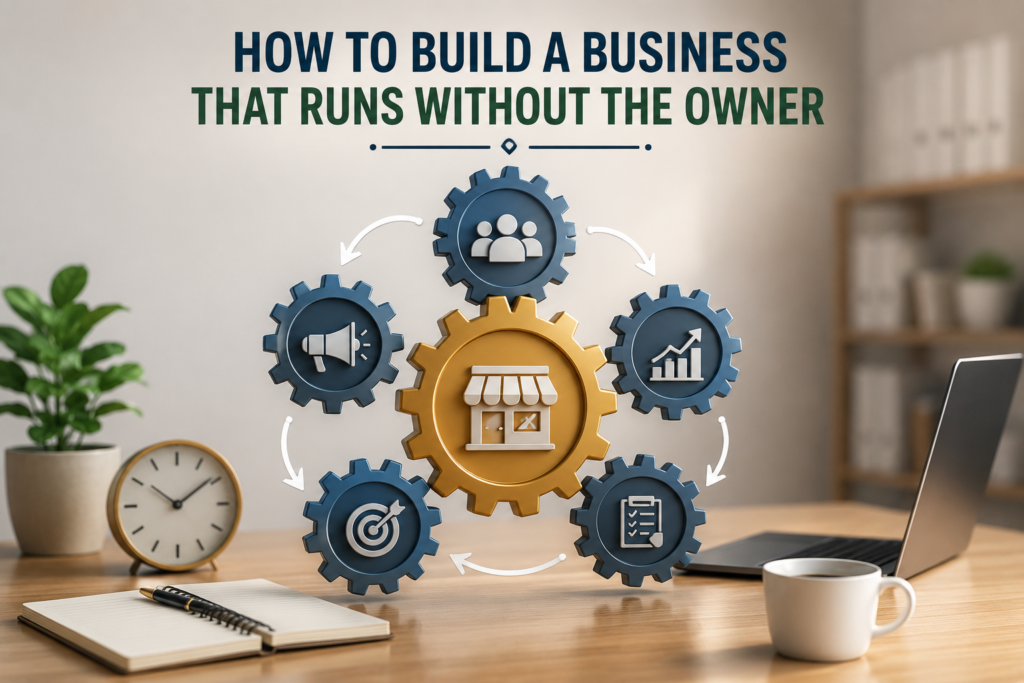
Many business owners start their journey with a simple goal: build a successful company that provides freedom, income, and long-term security. Yet as the business grows, many find themselves working longer hours than ever before. Every decision, customer issue, staff question, and operational challenge comes back to them. Instead of owning a business, they become trapped inside it. This is where the concept of building a business that runs without the owner becomes so important. A business should be an asset, not a job. Just as a strong seo ranking site can generate consistent leads without daily manual effort, a well-structured business can continue operating efficiently even when the owner steps away.
The reality is that many companies struggle because their systems depend too heavily on one person. Whether it is approving invoices, handling customer relationships, or making every strategic decision, the owner becomes the bottleneck. Sustainable growth happens when processes, people, and systems work together independently. The same principle applies to a successful seo ranking site, where structured foundations create predictable results over time rather than relying on constant intervention.
Why Most Businesses Depend Too Much on the Owner
In the early stages of business, it makes sense for founders to handle multiple responsibilities. They understand the product, know the customers, and often wear several hats. However, problems arise when this approach continues as the company grows.
Many business owners unknowingly create dependence by:
- Keeping critical knowledge in their heads
- Making every major decision themselves
- Avoiding delegation
- Failing to document processes
- Hiring people without clear responsibilities
As a result, employees constantly seek approval, projects slow down, and business growth becomes limited by the owner’s availability.
The first step toward creating an independent business is recognizing that growth requires systems rather than personal effort alone.
Build Systems Before You Need Them
Businesses that operate smoothly without the owner are usually built on strong systems. A system is simply a repeatable way of completing a task.
Think about every important function in your company:
- Customer onboarding
- Sales processes
- Staff training
- Marketing activities
- Financial management
- Customer support
Each area should have documented procedures that anyone in the team can follow.
When employees know exactly how things should be done, consistency improves and dependency on the owner decreases. New team members can also become productive much faster because the business already has a clear framework in place.
Businesses that scale successfully often spend significant time documenting and refining these systems long before they become necessary.
Hire People Who Can Think, Not Just Follow Instructions
Many business owners unintentionally hire people who wait for direction instead of taking initiative. While skills are important, problem-solving ability and accountability are often more valuable in the long term.
A business that can operate independently requires team members who:
- Take ownership of their responsibilities
- Make informed decisions
- Solve problems proactively
- Communicate effectively
- Focus on outcomes rather than tasks
The goal is not simply to build a workforce. The goal is to build a leadership culture where responsibility is shared across the organisation.
When employees understand company objectives and have the authority to make decisions, the owner no longer needs to be involved in every detail.
Create Clear Roles and Accountability
Confusion creates dependence.
If employees are unsure who is responsible for specific outcomes, they naturally escalate decisions upward. Eventually, the owner becomes responsible for solving every issue.
To avoid this, define clear responsibilities for every position within the business.
Each team member should understand:
- What they are responsible for
- What success looks like
- Which decisions they can make independently
- Who they report to
When accountability becomes part of company culture, operational efficiency improves dramatically.
Business owners often discover that many problems disappear simply because expectations become clearer.
Build a Strong Management Layer
One of the biggest differences between small businesses and scalable businesses is management structure.
Owners should not directly manage every employee. Instead, strong managers should oversee departments and handle day-to-day operations.
A capable management team helps:
- Maintain productivity
- Resolve internal challenges
- Support employees
- Monitor performance
- Execute business strategies
This creates an environment where the owner can focus on growth opportunities instead of daily operational tasks.
Many of today’s successful companies grew because founders shifted from managing people to leading the business itself.
Use Technology to Reduce Manual Work
Technology has made it easier than ever to automate routine activities.
Businesses can automate:
- Appointment scheduling
- Customer communication
- Invoice generation
- Reporting
- Lead management
- Marketing campaigns
Automation reduces errors, improves consistency, and frees valuable time for higher-level activities.
Modern business growth increasingly depends on smart technology adoption. Companies that embrace tools such as AI SEO strategies often discover that efficiency gains extend beyond marketing and into broader business operations.
The objective is not to remove people from the process entirely. Instead, it is to eliminate repetitive tasks that consume valuable resources.
Focus on Building a Strong Brand
A business that relies solely on the owner’s reputation will always face limitations.
Customers should trust the company itself, not just the founder.
This means creating:
- Consistent customer experiences
- Strong company values
- Reliable service delivery
- Professional communication
- Recognisable market positioning
Many organisations grow significantly once customers begin recommending the business because of the brand rather than a specific individual.
For example, businesses working with the best Birmingham seo company often value proven systems, results, and expertise rather than relying on one person’s involvement in every project.
A strong brand creates trust that continues working even when the owner is not present.
Measure Performance with Data
Businesses cannot improve what they do not measure.
Owners who want independence need visibility into performance without personally overseeing every activity.
Key metrics should be reviewed regularly across areas such as:
- Revenue growth
- Customer retention
- Sales performance
- Team productivity
- Customer satisfaction
When leaders can access accurate information quickly, decision-making becomes faster and more effective.
Data provides confidence that the business is moving in the right direction even when the owner is focused elsewhere.
Develop Multiple Growth Channels
Businesses become vulnerable when growth depends on a single source of customers.
Diversification creates stability.
Potential growth channels may include:
- Referrals
- Partnerships
- Content marketing
- Email marketing
- Paid advertising
- Organic search visibility
Many businesses seeking sustainable growth invest in Local SEO to attract customers consistently from their target markets.
Likewise, organisations that work with a seo specialist Birmingham often aim to create predictable lead generation systems that continue delivering opportunities month after month.
The more diversified your customer acquisition strategy becomes, the less dependent your business is on any individual activity or person.
Prepare the Business to Operate Without You
A useful exercise is to imagine taking a three-month break from your business.
Ask yourself:
- What would stop functioning immediately?
- Which decisions require your approval?
- What information exists only in your head?
- Which relationships depend entirely on you?
The answers reveal where dependency still exists.
Every improvement you make to systems, processes, delegation, and leadership reduces those risks.
Businesses that can function effectively without the owner are typically more profitable, easier to scale, and significantly more valuable.
Investors and buyers are often willing to pay higher valuations for companies that do not depend on a single individual.
Final Thoughts
Building a business that runs without the owner does not happen overnight. It requires deliberate planning, strong systems, capable people, clear accountability, and consistent improvement. The goal is not to remove yourself completely from the company but to create an organisation that continues operating successfully whether you are present or not. Business owners who embrace this mindset gain greater freedom, stronger growth opportunities, and a more valuable company in the long run. Just as businesses invest in SEO, work with the best seo company in Birmingham, and seek guidance from an Expert to strengthen their online presence, they should also focus on building internal structures that create long-term independence. Ultimately, the strongest businesses are those that can continue growing, serving customers, and generating results without constant owner involvement—much like a successful seo ranking site that continues delivering value long after the initial work has been completed.