

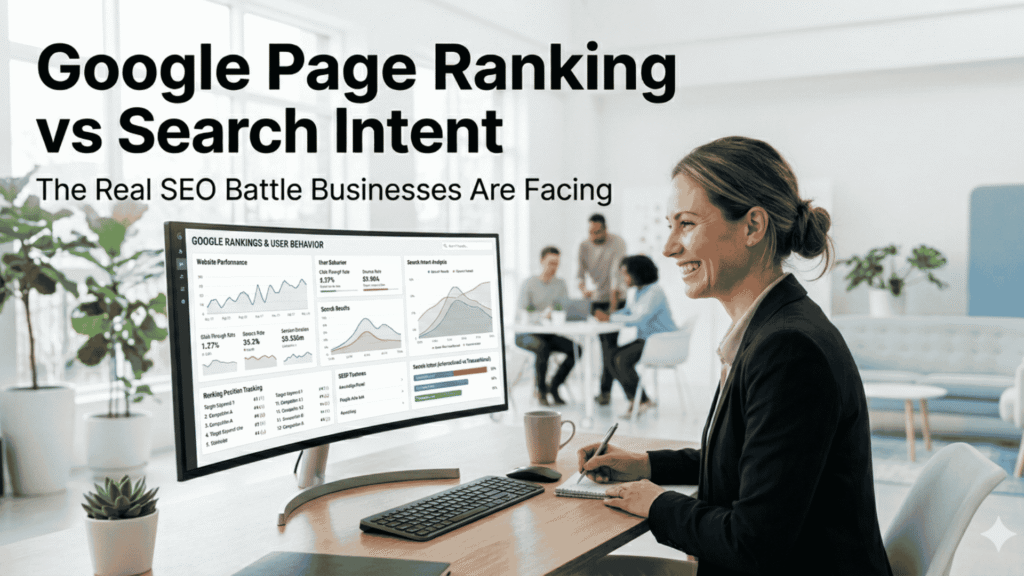
Every business owner has experienced the frustration of publishing a page, adding keywords, improving design, and still watching competitors dominate search results. Pages that appear technically optimized often fail to generate enquiries, traffic, or conversions because they focus too heavily on rankings and not enough on what users actually want.
This is where the real SEO battle begins.
Many websites chase algorithms instead of understanding people. They try to manipulate visibility with outdated tactics while ignoring the actual reason someone searches on Google. Search engines have evolved beyond simple keyword matching, and businesses that fail to adapt are now losing visibility even after investing heavily in content creation.
The conversation around google page ranking has changed dramatically over the last few years. Higher rankings alone no longer guarantee business growth. If a page does not satisfy user intent, visitors leave quickly, engagement drops, and Google starts reducing trust in that page over time.
Why Search Intent Matters More Than Ever
Search intent is the reason behind a search query. Every user searching online is trying to solve a problem, compare options, learn something, or make a buying decision. Google’s algorithm is now designed to identify which pages genuinely satisfy those goals.
For example, someone searching for dental treatment costs wants pricing clarity and trustworthy information. Someone looking for local services expects fast answers, nearby solutions, and proof of credibility. A page overloaded with keywords but lacking useful answers rarely performs well in modern search results.
This shift has transformed how businesses should approach content. Instead of writing for search engines first, websites must focus on solving real user problems through structured and trustworthy information.
Businesses investing in SEO often make the mistake of targeting only broad keywords without understanding user behavior. That approach may increase impressions temporarily, but it rarely builds sustainable rankings or qualified leads.
The Difference Between Rankings and Relevance
A common misconception in digital marketing is that rankings automatically create conversions. In reality, relevance drives performance.
Google measures how users interact with content. If visitors quickly return to search results because the page failed to answer their query, that sends negative engagement signals. On the other hand, pages that keep users engaged tend to gain stronger visibility over time.
This is why practical content consistently outperforms shallow optimization.
Businesses that understand customer pain points create stronger long-term authority. Instead of writing generic information, they answer specific concerns, explain real scenarios, and guide users toward informed decisions.
For example, a local service business targeting search engine optimization birmingham would struggle if its pages focused only on repeating keywords without addressing local competition, business challenges, and conversion-focused strategies.
Search engines are now rewarding expertise, clarity, and usefulness rather than aggressive keyword placement.
How Google Evaluates User Satisfaction
Modern ranking systems analyze multiple behavioral and quality-based signals. While Google does not reveal every ranking factor publicly, practical SEO experience shows several consistent patterns.
Pages that perform well usually:
- Solve a specific problem clearly
- Match the exact search intent
- Provide trustworthy and experience-based insights
- Maintain readable formatting and logical structure
- Offer unique information instead of recycled content
- Demonstrate expertise within the topic
Google increasingly evaluates whether a page appears genuinely helpful rather than artificially optimized.
This explains why many businesses lose rankings even after publishing large amounts of content. Quantity alone no longer creates authority.
A page discussing seo cost in birmingham, for example, should explain pricing variables, local competition, service scope, and realistic expectations rather than publishing vague marketing claims.
The Rise of Experience-Based Content
One of the biggest changes in search visibility is the growing importance of practical expertise.
Google now prioritizes content that demonstrates real-world understanding. Businesses with direct industry experience have a stronger opportunity to build trust because they can discuss realistic challenges, implementation strategies, and actual outcomes.
This aligns with Google’s EEAT principles: Experience, Expertise, Authoritativeness, and Trustworthiness.
Users are no longer satisfied with surface-level blogs repeating the same information found everywhere else online. They want detailed insights, practical guidance, and accurate answers.
This is especially important for local businesses competing in industries where trust heavily influences buying decisions. A clinic investing in dentist seo birmingham, for instance, would benefit more from patient-focused educational content than pages overloaded with repetitive keywords.
Content that reflects real customer journeys performs better because it aligns naturally with how users search.
Why Traditional Keyword Stuffing Fails
Older SEO strategies relied heavily on exact-match keyword repetition. While this once influenced rankings, modern algorithms now recognize unnatural optimization patterns.
Excessive keyword usage reduces readability and damages trust. Visitors immediately notice when content feels robotic or manipulative.
Google’s systems are designed to understand context, meaning, and relationships between topics. This means pages can rank well without repeating the same phrase unnaturally.
Businesses focused purely on ranking manipulation often overlook what truly improves visibility:
- Clear information architecture
- Helpful content depth
- Strong topical relevance
- Positive user engagement
- Trust-building signals
- Fast and accessible experiences
A business searching for an seo agency near me is usually looking for expertise, transparency, and proven understanding rather than pages overloaded with promotional claims.
AI Search Is Changing Content Expectations
The growth of AI-driven search experiences is reshaping how content is evaluated.
Search engines now analyze context more deeply and summarize information more intelligently. This means low-quality content created solely for rankings is becoming less effective.
AI SEO strategies now require businesses to create genuinely informative resources that answer layered user questions. Content must demonstrate depth, accuracy, and practical value.
At the same time, Local SEO continues becoming more important because users increasingly expect personalized and geographically relevant results.
Businesses that combine local relevance with experience-based content are building stronger visibility than those relying only on technical optimization.
This shift also explains why many websites experience ranking volatility after algorithm updates. Pages lacking intent alignment often lose visibility even if they previously ranked well.
Understanding the Real Purpose of Search Engines
Search engines exist to deliver the best possible answer to users.
That single principle explains nearly every major algorithm update.
Google wants users to trust search results. If poor-quality pages dominate rankings, users lose confidence in the platform itself. As a result, Google continuously improves its ability to identify genuinely useful content.
Businesses that focus only on rankings often miss this larger objective.
Instead of asking, “How do we rank higher?” successful websites ask:
- What problems are users trying to solve?
- What information are competitors missing?
- How can we make the experience clearer?
- What builds trust quickly?
- What concerns prevent conversions?
This mindset creates stronger long-term performance because it aligns directly with user behavior.
Even highly competitive markets targeting search engine optimisation birmingham are now seeing better results from informative, experience-based strategies instead of aggressive optimization shortcuts.
The Future of Google Rankings
The future of search visibility belongs to businesses that understand people better than algorithms.
Technical optimization still matters, but it works best when combined with strong intent alignment and trustworthy information.
Businesses should focus on:
- Creating content around real customer questions
- Publishing experience-driven insights
- Improving readability and structure
- Building topical authority over time
- Maintaining accurate and trustworthy information
- Prioritizing user satisfaction instead of keyword density
This approach creates sustainable visibility because it reflects how modern search engines evaluate quality.
The real battle is no longer between websites competing for keywords. It is between content that genuinely helps users and content created only to manipulate rankings.
As search continues evolving, businesses that prioritize clarity, expertise, and user intent will continue outperforming competitors relying on outdated tactics.
In the end, google page ranking is no longer just about visibility. It is about trust, usefulness, and delivering the right answer at the right moment. Businesses that understand this shift are far more likely to achieve lasting growth through SEO.