

A growing number of business owners are facing the same frustrating situation. Their website ranks for a few traditional search terms, they receive occasional enquiries, and their online listings appear active, yet enquiries still fluctuate unpredictably. At the same time, potential customers are now discovering companies through conversational search tools, voice assistants, and AI-generated recommendations instead of relying only on standard search result pages. For many companies, seo for local business has become more complex because visibility now depends on how accurately a brand appears across multiple search environments.
Many service businesses also struggle to understand whether traditional optimisation methods are enough anymore. Some invest heavily in directory listings, reviews, and map visibility while ignoring how artificial intelligence platforms interpret business information. Others focus entirely on automated content strategies while neglecting trust signals that still influence local discovery. This confusion is why seo for local business has become one of the most discussed topics among companies trying to maintain visibility while adapting to changing search behaviour.
Why Search Behaviour Is Rapidly Changing
People no longer search in the same way they did a few years ago. Instead of typing short phrases into a search engine, users increasingly ask complete questions. They want direct answers, recommendations, comparisons, pricing expectations, and trustworthy local options immediately.
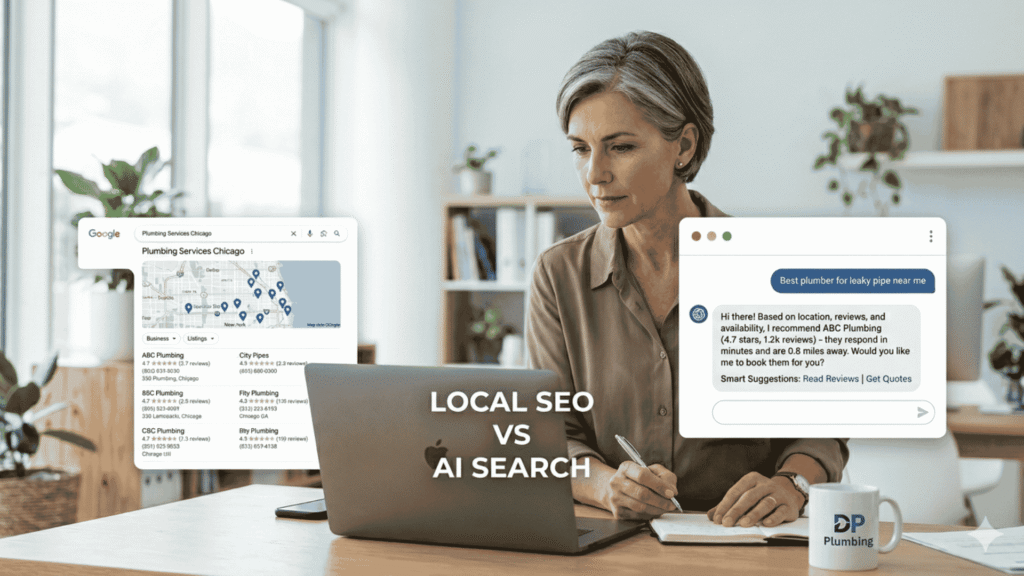
For example, someone searching for a nearby electrician may ask a conversational tool:
“Who is the most trusted emergency electrician near me with fast response times?”
Search systems now analyse intent, authority, customer sentiment, business consistency, and contextual relevance before generating recommendations. This shift means businesses can no longer rely only on traditional ranking methods.
Search platforms are evolving into answer engines. Instead of simply displaying ten blue links, they now attempt to predict the best solution for a user’s problem. Businesses that fail to structure their information clearly may become invisible, even if they previously ranked well.
Traditional Search Optimisation Still Matters
Despite rapid technological changes, foundational visibility signals remain extremely important. Search engines still evaluate relevance, trustworthiness, proximity, authority, and consistency when determining which companies deserve visibility.
Several core elements continue to influence business discovery:
- Consistent business information across directories
- Well-structured service pages
- Fast website performance
- Helpful informational content
- Genuine customer reviews
- Strong location relevance
- Clear service explanations
- Accurate business categories
These fundamentals help search systems understand what a company does, where it operates, and why customers trust it.
Businesses that ignore these essentials often struggle to build long-term visibility because search engines require reliable data before recommending any company confidently.
The Rise of AI-Driven Discovery
AI-powered search systems interpret information differently from traditional search algorithms. Instead of only matching keywords, they attempt to understand context, relationships, expertise, and user intent.
This changes how businesses should present information online.
AI systems often evaluate:
- Topic depth and expertise
- Consistency of brand information
- Customer sentiment patterns
- Real-world authority signals
- Contextual relevance
- Structured information accuracy
- Trust indicators across multiple platforms
A company with shallow content, vague service descriptions, or inconsistent information may struggle to appear in AI-generated responses.
Modern search experiences also prioritise clarity. Businesses that explain services transparently, answer practical customer questions, and demonstrate real expertise are more likely to become trusted sources.
Where Businesses Commonly Make Mistakes
Many companies either focus entirely on technical ranking methods or completely chase automation trends without balancing both approaches.
One common mistake is publishing large volumes of low-quality content generated without practical expertise. While this may increase page count temporarily, it rarely builds trust or long-term visibility.
Another issue occurs when businesses optimise only for broad traffic rather than actual customer intent. A company may attract visitors who never convert because the information does not align with real purchasing behaviour.
Some businesses also overlook local trust signals. For example, a trades company may create generic pages without demonstrating proof of work, customer experience, or service area authority.
This is particularly important for service-based industries because trust heavily influences customer decisions.
Why Authority and Experience Matter More Than Ever
Search systems increasingly prioritise evidence of real expertise. Businesses that demonstrate practical industry knowledge are far more likely to gain visibility compared to companies publishing generic content.
This means companies should focus on:
- Real customer problems
- Practical solutions
- Transparent service explanations
- Experience-based insights
- Detailed service information
- Accurate location relevance
A knowledgeable seo expert birmingham businesses rely on will often prioritise topical authority over excessive content production because depth and trust now matter more than quantity.
Similarly, a skilled seo consultant in birmingham understands that visibility depends on how effectively a business communicates expertise across its entire digital presence.
Why Location Relevance Still Influences Visibility
Even as AI-generated search expands, geographical relevance remains highly important. Search systems still attempt to connect users with nearby, trustworthy providers.
For example, businesses targeting seo hall green audiences must ensure that location signals remain accurate across websites, maps, citations, and customer references.
This becomes even more important for emergency or service-based industries where proximity strongly influences conversions.
A practical example is local seo for plumbers birmingham campaigns, where visibility often depends on combining location relevance with trust indicators such as reviews, response speed, and clear service coverage.
Many companies mistakenly assume advanced automation alone will solve visibility problems, but local credibility continues to influence search recommendations heavily.
The Difference Between Traditional and AI-Based Optimisation
Traditional optimisation primarily focuses on improving rankings within standard search result pages.
AI-based optimisation focuses on improving how systems interpret, trust, and recommend information conversationally.
While both approaches overlap, their priorities differ slightly.
Traditional strategies often emphasise:
- Ranking positions
- Page indexing
- Technical structure
- Link acquisition
- Search visibility
AI-focused strategies place greater emphasis on:
- Semantic clarity
- Entity relationships
- Topical authority
- Conversational relevance
- Information accuracy
- Trustworthiness
Businesses that combine both approaches are generally better positioned for long-term visibility.
Why Businesses Need a Balanced Strategy
Companies that depend entirely on outdated ranking methods risk losing visibility as search experiences evolve.
At the same time, businesses that ignore foundational optimisation principles may struggle to establish enough credibility for AI systems to trust their information.
A balanced strategy helps businesses:
- Improve local discoverability
- Strengthen customer trust
- Increase conversion opportunities
- Build long-term authority
- Adapt to changing search behaviour
- Improve informational relevance
This balanced approach is why many businesses now work with a local search agency birmingham companies trust to combine technical optimisation with modern AI-focused visibility strategies.
The Role of Content in Future Search Visibility
Content quality is becoming one of the strongest differentiators in modern search.
Search systems increasingly evaluate whether content genuinely helps users solve problems rather than simply targeting phrases mechanically.
Helpful content usually includes:
- Clear explanations
- Industry expertise
- Real examples
- Service transparency
- Practical guidance
- Honest expectations
Businesses that consistently create useful, experience-based information are more likely to gain visibility across both traditional and AI-driven discovery platforms.
This is where SEO, AI SEO, and Local SEO strategies begin overlapping more naturally because all three depend heavily on trust, relevance, and information quality.
Do You Really Need Both?
For most businesses, the answer is yes.
Traditional optimisation still helps search engines understand website structure, service relevance, and geographical targeting. Meanwhile, AI-driven search visibility helps businesses remain discoverable within conversational and recommendation-based search environments.
Ignoring either side creates limitations.
Businesses relying only on traditional methods may gradually lose exposure as user behaviour changes.
Businesses relying only on AI-focused strategies may struggle to establish the trust signals and foundational relevance required for consistent visibility.
The companies most likely to succeed are those building authority, clarity, trust, and customer-focused information across every search environment.
As search behaviour continues evolving, seo for local business will increasingly depend on combining technical foundations with trustworthy, experience-driven information that both search engines and AI systems can confidently recommend.