

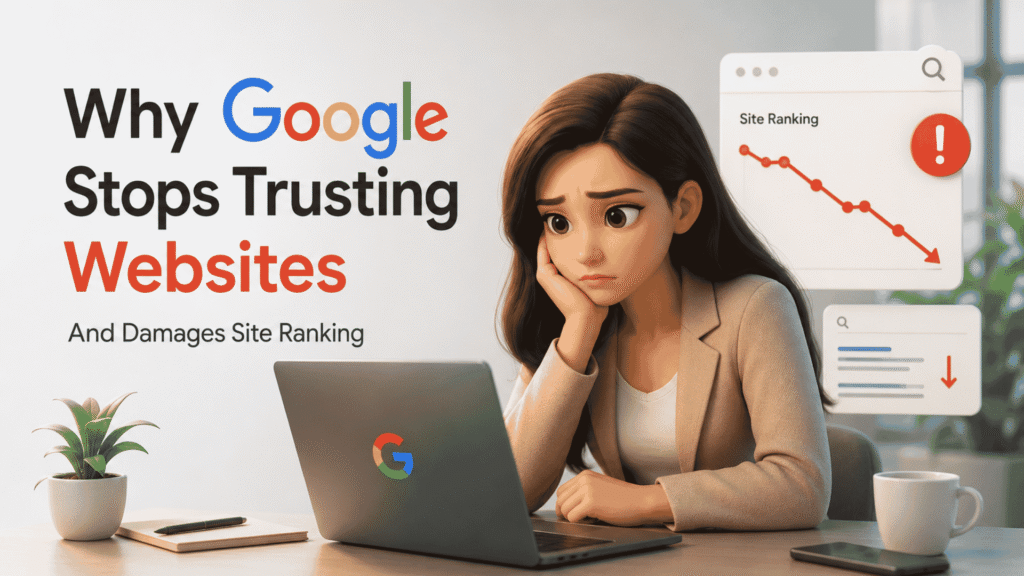
Many business owners notice the same frustrating pattern. Their website performs well for months, enquiries increase, rankings improve, and then suddenly traffic drops without warning. Pages that once appeared on the first page disappear, leads slow down, and competitors take over valuable search positions.
In most cases, this does not happen because of one algorithm update alone. It happens because Google slowly loses confidence in the quality, trust, and consistency of a website. Search engines are now focused on identifying websites that genuinely help users instead of websites built only to manipulate rankings. Once trust signals weaken, recovery becomes much harder.
Understanding why this happens is essential for businesses investing in SEO, content marketing, and long-term digital visibility.
Google Measures Trust More Than Most Websites Realise
Google’s ranking systems are designed to evaluate whether a website deserves visibility. Search engines no longer rely only on keywords or backlinks. They analyse behavioural signals, expertise, content quality, website structure, user satisfaction, and overall reliability.
A website may look professional on the surface while still sending negative quality signals behind the scenes. Thin pages, outdated information, misleading content, poor navigation, and inconsistent updates slowly reduce credibility.
This is why many websites experience ranking drops even when they continue publishing content regularly. Publishing more pages does not automatically increase authority if the content lacks originality, expertise, or value.
The biggest problem is that many businesses still focus on search engine tricks instead of user trust.
Low-Quality Content Weakens Authority Over Time
One of the fastest ways to lose visibility is by publishing repetitive or shallow content. Google now recognises when websites create pages purely to target keywords instead of solving real user problems.
Many websites publish blogs that repeat the same information already available online. They rewrite competitor content, stuff keywords unnaturally, and create articles without practical insights. Over time, this damages overall website quality.
Search engines now prioritise content that demonstrates experience and genuine understanding. Businesses that share real examples, practical challenges, solutions, and industry expertise perform far better than websites using generic AI-generated articles without editing or expertise.
This is where modern AI SEO strategies often fail. Automation can help with research and structure, but content still requires human expertise, factual accuracy, and unique perspectives. Websites that rely completely on automated publishing often experience declining trust signals after algorithm updates.
Poor User Experience Sends Negative Signals
Google wants users to find answers quickly and easily. If visitors land on a page and leave immediately because the experience is frustrating, rankings can decline.
Several technical and usability issues contribute to trust loss:
- Slow-loading pages
- Confusing navigation
- Intrusive popups
- Broken links
- Mobile usability problems
- Poor readability
- Excessive advertising
- Thin service pages
When users struggle to interact with a website, Google interprets this as a poor search result experience.
Many businesses invest heavily in content while ignoring technical performance. However, even strong content can underperform if the website experience feels unreliable or outdated.
Manipulative SEO Practices Still Damage Rankings
Although search algorithms have evolved significantly, some businesses continue using outdated optimisation tactics that eventually lead to penalties or visibility loss.
Common harmful practices include:
- Buying low-quality backlinks
- Creating doorway pages
- Over-optimising anchor text
- Copying competitor content
- Publishing duplicate location pages
- Hiding keywords unnaturally
- Using misleading redirects
Google’s systems are increasingly effective at identifying unnatural behaviour patterns. Websites that attempt to manipulate rankings instead of earning authority naturally often experience unstable performance.
Sustainable SEO focuses on trust, expertise, and long-term relevance rather than shortcuts.
Inconsistent Local Signals Reduce Credibility
For businesses targeting regional customers, consistency across local platforms matters significantly. Google compares website information with business listings, directories, reviews, and external citations.
If addresses, phone numbers, services, or business categories appear inconsistent online, trust can weaken. This becomes especially important for companies competing in local markets where credibility strongly influences visibility.
Many businesses investing in birmingham local seo overlook the importance of maintaining accurate and consistent local data across all digital platforms. Even small inconsistencies can confuse search engines and reduce local ranking strength.
Similarly, businesses focused on local seo birmingham campaigns often fail to update outdated service pages, resulting in weaker local relevance over time.
Lack of Topical Expertise Hurts Long-Term Visibility
Google increasingly rewards websites that demonstrate deep knowledge within specific industries instead of covering unrelated topics randomly.
For example, an agency publishing highly detailed content around technical optimisation, user behaviour, and search strategy develops stronger authority than a website producing generic articles across dozens of unrelated subjects.
Businesses must build topical relevance consistently through connected content, strong service pages, practical insights, and accurate information.
This is particularly important in competitive industries where trust determines ranking stability.
For example, companies offering seo consultation birmingham services need content that reflects real-world expertise, strategic understanding, and measurable insights rather than vague marketing language.
Industry-specific authority also matters heavily in niche markets. Businesses focusing on estate agent seo birmingham campaigns often perform better when their websites demonstrate deep understanding of property industry search behaviour instead of publishing broad generic SEO advice.
Google Evaluates Website Reputation Beyond the Website Itself
Search engines now analyse external trust signals more aggressively than before. Reviews, mentions, backlinks, author reputation, and brand credibility all contribute to ranking strength.
A technically optimised website can still struggle if its reputation appears weak externally.
This is why recognised brands and experienced businesses often maintain stronger visibility even during major algorithm changes. Google sees consistent evidence that users trust these companies.
Many businesses ignore reputation building and focus entirely on rankings. However, strong rankings usually follow strong credibility rather than the other way around.
Even among competitive Birmingham seo agencies, the websites maintaining stable rankings are usually those demonstrating real authority, expertise, and industry trust across multiple channels.
Thin Service Pages Create Major Trust Problems
One of the most overlooked ranking issues is weak service page quality. Many websites create short pages with little meaningful information simply to target keywords.
Google expects service pages to answer important user questions clearly:
- What problems does the service solve?
- How does the process work?
- What experience supports the service?
- What results can users realistically expect?
- Why should users trust the business?
Pages that fail to answer these questions often struggle to maintain visibility.
High-performing websites typically create comprehensive pages that combine informational value with genuine expertise. This improves engagement, increases trust, and supports stronger ranking stability.
Websites Lose Rankings When They Stop Evolving
Search behaviour constantly changes. User expectations change. Competitors improve. Algorithms become more advanced.
Websites that remain static gradually lose relevance even without penalties.
Businesses must continually improve content quality, technical performance, user experience, and topical depth. Search visibility is not permanent. It requires continuous refinement based on user intent and search engine expectations.
Strong Local SEO strategies help businesses maintain visibility by aligning website content with evolving search patterns, regional intent, and user expectations.
At the same time, effective SEO today requires balancing technical optimisation with real expertise, user trust, and practical value.
The businesses that maintain strong rankings long-term are usually the ones that prioritise helping users genuinely rather than simply chasing algorithms.
Ultimately, sustainable site ranking google performance depends on whether Google believes a website consistently deserves user trust.