



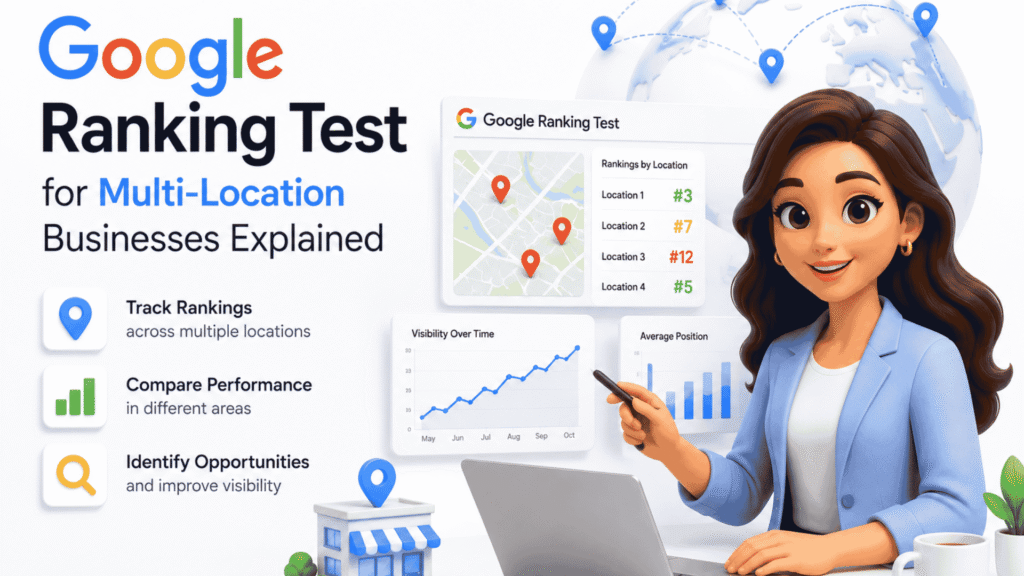
A business ranks well in one city, but disappears in another even when the services, website structure, and branding are almost identical. That is one of the most common frustrations faced by multi-location brands trying to scale organic visibility. Many companies assume rankings should automatically transfer from one location to another, but search engines evaluate local relevance, intent signals, entity trust, and geographic authority independently. Understanding how a google ranking test works helps businesses identify why one branch performs strongly while another struggles to appear in local search results.
Why Multi-Location Rankings Behave Differently
Search engines do not treat every location page equally. Even if two pages share similar service descriptions, Google evaluates local relevance based on multiple signals:
- Geographic proximity
- Local backlinks
- Business profile consistency
- Local reviews
- Search intent matching
- User engagement signals
- Entity relationships
- On-page uniqueness
A company with ten locations may see completely different outcomes for each branch because local search operates on micro-market competition rather than domain authority alone.
For example, a business may rank easily in a smaller town but struggle in a competitive metro area where stronger entities dominate local results. This becomes more noticeable in industries where search intent changes by region.
What a Google Ranking Test Actually Measures
A ranking test is not simply checking keyword positions in a tool. Practical testing involves evaluating how Google responds to different local relevance signals over time.
The process typically measures:
1. Location-Based Search Visibility
Businesses need to monitor rankings from different geographic coordinates because results vary depending on user proximity. A page ranking #2 in one area may not appear in the top 20 results a few miles away.
2. Local Landing Page Relevance
Google analyzes whether a page genuinely serves a specific location. Thin or duplicated location pages often fail because they provide minimal unique value.
3. Internal Linking Distribution
Pages connected strategically within a site architecture usually receive stronger contextual authority. Many multi-location websites unintentionally isolate location pages, weakening their discoverability.
4. User Behavior Signals
Engagement metrics such as click-through rates, time on page, and interaction patterns help search engines understand usefulness. If users quickly leave a page, rankings may decline despite strong technical optimization.
5. Entity Trust Signals
Search engines compare website data with business profiles, citations, maps data, and external mentions to verify legitimacy.
Common Mistakes Found During Multi-Location Testing
Duplicate Location Content
Many businesses reuse nearly identical text across all city pages. This creates low differentiation signals and reduces topical uniqueness.
Instead of changing only the city name, pages should include:
- Local case studies
- Regional customer concerns
- Service variations
- Area-specific FAQs
- Nearby landmarks
- Local market insights
Google increasingly rewards pages that demonstrate practical local expertise.
Over-Optimization of Keywords
Businesses often force location modifiers unnaturally throughout pages. This creates poor readability and weakens trust signals.
Modern search systems understand semantic relevance without excessive repetition. Natural language optimization usually performs better than mechanical keyword insertion.
Weak Local Authority
A business may have strong national visibility but weak local authority in specific regions. Local backlinks, local mentions, and region-specific engagement still matter heavily.
This is where businesses working with a specialized seo consultancy birmingham often discover that local authority gaps are preventing visibility improvements despite strong technical SEO foundations.
How Google Evaluates Multi-Location Intent
Search intent changes significantly between locations.
For example:
- A user searching in a major city may expect immediate service availability.
- A suburban user may prioritize pricing or proximity.
- Rural searches may favor broader service coverage.
Google adjusts results based on behavioral patterns from each market. Multi-location businesses that ignore these variations usually struggle with inconsistent rankings.
A proper testing framework analyzes:
- Search modifiers
- Device behavior
- Time-based search trends
- Local competitor density
- SERP feature changes
- Map pack volatility
The Role of Local Landing Pages
Location pages should function as standalone local resources rather than doorway pages.
Strong location pages usually contain:
- Unique service explanations
- Team information
- Real customer proof
- Local operational details
- Structured data
- Clear navigation paths
Businesses relying solely on generic templates often fail to build location relevance at scale.
A professional birmingham seo consultant may also identify technical issues such as indexation conflicts, canonical errors, or weak crawl paths that affect local visibility.
How AI Is Changing Ranking Evaluation
Modern ranking systems increasingly rely on contextual understanding instead of simple keyword matching. Machine learning models evaluate topical depth, intent satisfaction, and trust consistency more effectively than older algorithms.
This shift has increased the importance of:
- Topical authority
- Content usefulness
- Real-world expertise
- Brand entity recognition
- User engagement quality
As a result, many companies are adapting their content strategies around AI SEO methodologies that focus on semantic relationships and intent mapping rather than repetitive keyword placement.
Practical Testing Methods Used by Experienced SEO Teams
Advanced testing usually includes several layers of analysis.
Grid-Based Rank Tracking
Instead of tracking a single keyword position, businesses analyze visibility across geographic grids to understand proximity influence.
Competitor Overlap Analysis
This identifies which competitors dominate specific regions and why they outperform other businesses locally.
SERP Intent Testing
Search results are analyzed to determine whether informational, transactional, or navigational intent dominates specific queries.
Page Differentiation Audits
Location pages are reviewed to identify duplication patterns and missing regional signals.
Many birmingham seo companies perform these audits when businesses experience ranking inconsistencies between branches.
Why Local Signals Matter More Than Ever
Google’s local ecosystem combines:
- Maps data
- Reviews
- Website signals
- Behavioral patterns
- Citation consistency
- Entity associations
Because of this, businesses cannot rely solely on traditional SEO practices anymore. Local trust validation has become increasingly important for sustained rankings.
For multi-location brands, this means every branch must establish:
- Independent credibility
- Accurate business information
- Strong local engagement
- Unique location relevance
The Growing Importance of Local Experience Signals
Search engines increasingly evaluate whether businesses demonstrate actual regional experience rather than simply targeting keywords.
This includes:
- Locally relevant content
- Community involvement mentions
- Real operational presence
- Service-specific expertise
- Regional customer interactions
Companies offering Local SEO strategies often focus heavily on strengthening these practical trust indicators because they directly influence local search confidence.
What Businesses Should Monitor Regularly
Multi-location performance can shift quickly due to:
- Competitor activity
- Algorithm updates
- Review changes
- SERP layout changes
- User behavior shifts
Key metrics to monitor include:
- Local pack visibility
- Organic click-through rates
- Location page engagement
- Conversion paths
- Geographic ranking spread
- Indexed page health
Businesses investing in best seo services birmingham frequently prioritize ongoing testing because local search volatility continues increasing across competitive industries.
Final Thoughts
A successful google ranking test is not about checking a single keyword position. It is about understanding how search engines interpret location relevance, trust, engagement, and regional authority across multiple markets. Businesses that approach multi-location SEO with duplicated content and generalized optimization often face unstable visibility, while companies building unique local relevance tend to achieve stronger long-term results.
As search evolves, practical testing frameworks, entity validation, behavioral analysis, and regional intent optimization are becoming essential for scalable organic growth. Many organizations working with a seo services company birmingham eventually realize that sustainable multi-location visibility depends less on repeating keywords and more on demonstrating authentic local value in every market they target.