


Introduction
The way businesses grow has changed dramatically over the last decade. Many traditional companies still rely on methods that worked years ago, but today’s fastest-growing organisations are built around flexibility, technology, customer convenience, and recurring revenue.
Across the UK, business owners are facing new challenges. Rising costs, changing customer behaviour, digital competition, and economic uncertainty are forcing companies to rethink how they operate. The businesses achieving the strongest growth are not always the largest or oldest. In many cases, they are simply using smarter business models.
Understanding which models are outperforming traditional approaches can help business leaders identify new opportunities, strengthen profitability, and future-proof their companies.
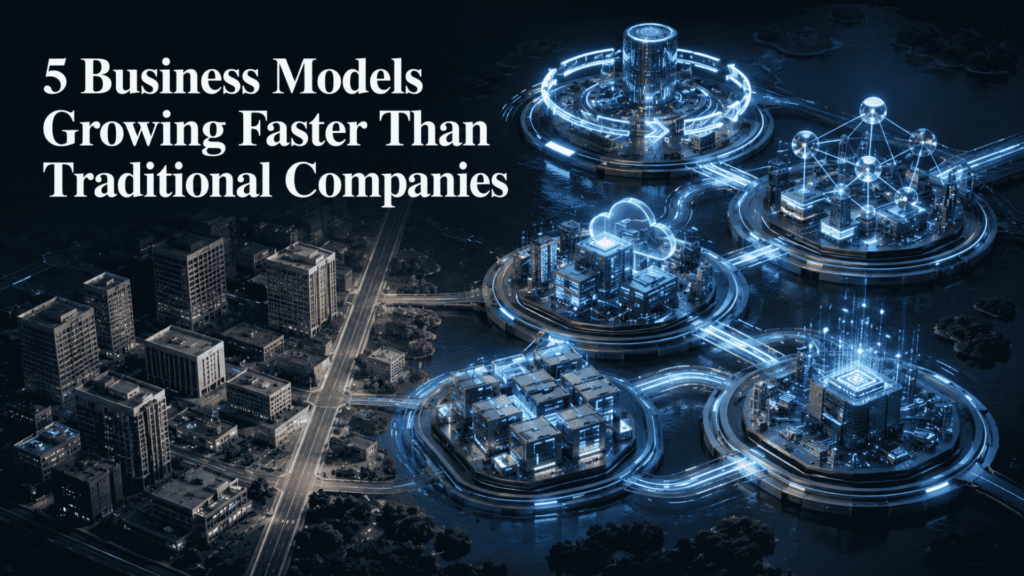
In this article, we’ll explore five business models that are growing significantly faster than many conventional businesses and why they are attracting attention from investors, customers, and entrepreneurs throughout the UK.
Why Business Models Matter More Than Ever
Many companies focus heavily on products, services, or marketing. While these are important, the underlying business model often determines long-term success.
A strong business model creates predictable income, improves customer retention, reduces operational costs, and makes scaling easier. Businesses that adapt their model to modern market demands are often able to grow faster than competitors offering similar products.
The UK’s business landscape is evolving rapidly, making it an ideal time to evaluate whether traditional operating methods are still the best route to growth.
1. Subscription-Based Businesses
Subscription models have transformed industries far beyond streaming services.
Today, businesses across software, professional services, retail, education, fitness, and healthcare are adopting recurring payment structures. Rather than relying on one-time purchases, they generate predictable monthly or annual revenue.
This approach creates greater financial stability and makes future planning easier. Customers also appreciate the convenience and ongoing value provided through subscriptions.
For UK businesses, recurring revenue can reduce dependence on seasonal demand and economic fluctuations. It also encourages stronger customer relationships because businesses focus on delivering ongoing value rather than continuously chasing new sales.
Examples include software platforms, membership communities, managed services, and specialist advisory firms.
2. Platform Businesses
Platform-based companies connect buyers and sellers rather than simply selling products themselves.
These businesses create value by facilitating interactions between different groups of users. Well-known examples can be found in transportation, property, recruitment, freelance services, and online marketplaces.
The reason platforms grow so quickly is that every new user increases the value of the network. More buyers attract more sellers, while more sellers attract additional buyers.
For UK entrepreneurs, platform models offer significant growth potential because expansion does not always require proportional increases in staff, inventory, or physical infrastructure.
Although building a successful platform requires careful planning, the long-term scalability can be remarkable.
3. Digital-First Service Businesses
Traditional service firms often depend heavily on local markets and manual processes. In contrast, digital-first businesses use technology to serve customers efficiently regardless of location.
Many consulting firms, agencies, financial advisors, training providers, and professional service companies have adopted digital delivery models.
Video meetings, cloud-based systems, automation tools, and digital workflows allow businesses to serve more clients while maintaining quality.
Companies that embrace digital operations also benefit from improved visibility online. This is where factors such as Google’s page experience become increasingly important, as user-friendly websites can improve customer engagement and support business growth.
Digital-first businesses are particularly attractive because they can expand without requiring major investments in physical premises or large operational teams.
4. Productised Service Models
One reason traditional service businesses struggle to scale is inconsistency.
Every project is different, pricing varies, and delivery processes can become difficult to manage. Productised services solve this problem by packaging expertise into clearly defined solutions with fixed pricing and standardised delivery.
Instead of creating bespoke proposals for every client, businesses offer structured service packages.
This approach simplifies sales, improves efficiency, and makes revenue more predictable.
Many UK agencies, consultants, marketing providers, and technology companies are successfully adopting this model because customers appreciate transparency and faster decision-making.
For example, some firms offering seo services in Birmingham have shifted towards packaged solutions that clearly define deliverables, timelines, and expected outcomes.
5. Hybrid AI-Powered Businesses
Artificial intelligence is no longer limited to large corporations.
Businesses of all sizes are using AI tools to improve customer support, content production, data analysis, forecasting, and operational efficiency.
The most successful organisations are not replacing people entirely. Instead, they combine human expertise with intelligent technology to increase productivity and improve customer experiences.
This hybrid approach allows businesses to serve more customers without dramatically increasing costs.
Companies investing in AI SEO strategies are already seeing how technology can support research, content planning, and performance analysis while still relying on human judgement and creativity.
As AI adoption increases across the UK economy, businesses that learn how to integrate these tools effectively are likely to gain a competitive advantage.
What UK Businesses Can Learn From These Models
Although these five business models operate differently, they share several common characteristics.
They prioritise customer convenience.
They create scalable systems.
They generate more predictable revenue.
They use technology to improve efficiency.
Most importantly, they focus on long-term value rather than short-term transactions.
This shift is particularly important in competitive markets where customer expectations continue to rise.
For businesses seeking stronger online visibility, working with experienced professionals can also help support growth. Many organisations turn to seo consultants Birmingham to improve digital performance, while others invest in seo in Birmingham strategies to strengthen their local presence.
Regardless of industry, visibility remains essential. Effective SEO continues to play a major role in helping businesses attract qualified customers online. Likewise, Local SEO can help companies connect with nearby customers who are actively searching for products and services.
However, technology and marketing alone are not enough. Sustainable growth still requires leadership, strategic planning, and a commitment to delivering genuine value. An Expert understanding of customer needs often remains the biggest competitive advantage of all.
How to Identify the Right Model for Your Business
Not every business should completely reinvent itself.
The best approach is often to evaluate which elements of these faster-growing models can be incorporated into existing operations.
A service company may introduce subscription packages.
A retailer may create a membership programme.
A consultancy could productise its most popular services.
A local business may expand through digital delivery.
Small adjustments can often create significant improvements in profitability and scalability.
The key is understanding how customer expectations are evolving and aligning your business model accordingly.
Conclusion
The businesses achieving the strongest growth today are not necessarily those with the largest budgets or longest histories. They are often the companies that have adapted their business models to reflect modern customer behaviour and market conditions.
Subscription businesses, platforms, digital-first operations, productised services, and hybrid AI-powered organisations are demonstrating that growth increasingly comes from smarter systems rather than simply working harder.
For UK business owners, the opportunity is clear. By studying these models and applying the principles that fit their organisation, they can build stronger, more resilient businesses capable of thriving in an increasingly competitive marketplace.
The future belongs to businesses that evolve. The question is not whether business models will continue to change, but whether companies are prepared to change with them.