

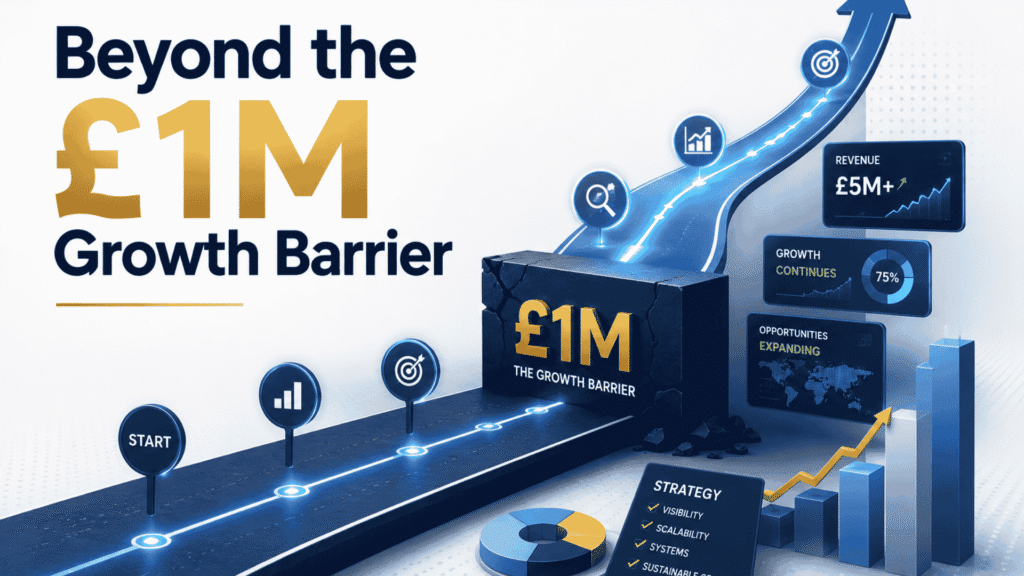
For many business owners, reaching £1 million in annual revenue feels like a major milestone. It represents years of hard work, customer acquisition, hiring staff, and building a reputation in the market.
Yet something interesting happens at this stage.
Many companies that successfully grow from start-up level to £1M revenue suddenly find themselves struggling to move further. Growth slows down. Margins become tighter. Competition increases. What once worked stops producing the same results.
Across the UK, thousands of businesses hit this growth ceiling every year.
The good news is that this challenge is not a sign that the business has reached its limit. In most cases, it simply means the company needs a different approach to scale successfully.
This article explores why businesses often stop growing after £1M revenue and what business leaders can do to continue expanding in an increasingly competitive market.
The £1M Revenue Trap Most Businesses Never Expect
The journey from £0 to £1M is usually driven by effort, reputation, and opportunity.
The founder is heavily involved in sales.
Customer relationships are personal.
Marketing decisions are often made quickly.
The business can adapt rapidly because the team is still relatively small.
However, once revenue approaches or exceeds £1M, the business enters a different stage of growth.
The systems that helped generate the first million often become the same systems that hold the company back.
Many owners continue operating as if they are running a small company when they are actually leading a growing organisation that requires stronger processes, clearer strategy, and better scalability.
This transition is where growth frequently stalls.
Problem 1: The Founder Becomes the Bottleneck
One of the most common reasons businesses stop growing is that too many decisions still depend on the owner.
Customers want to speak directly to the founder.
Major sales discussions require owner approval.
Staff members wait for instructions instead of taking initiative.
As revenue increases, this model becomes increasingly difficult to sustain.
The owner becomes overwhelmed while growth opportunities are missed because the business cannot move fast enough.
Successful companies beyond the £1M mark build leadership capacity. They create systems that allow the business to operate effectively without requiring constant founder involvement.
Growth becomes sustainable when responsibility is shared rather than centralised.
Problem 2: Marketing Stops Evolving
Many businesses achieve their first million through referrals and repeat customers.
While referrals remain valuable, they rarely provide enough predictable growth to support long-term expansion.
Markets change.
Consumer behaviour changes.
Competitors become more aggressive.
Businesses that rely entirely on traditional lead sources often discover that their growth pipeline becomes inconsistent.
This is where digital visibility becomes critical.
Today, potential customers conduct extensive online research before making purchasing decisions. If your business cannot be found during that research process, competitors often win the opportunity before you even know it exists.
A strong SEO strategy helps businesses generate qualified traffic consistently while reducing dependence on unpredictable lead sources.
Problem 3: The Market Has Changed
The business landscape in 2026 is very different from what it was just a few years ago.
Customers expect instant information.
Search behaviour continues to evolve.
Artificial intelligence is influencing how consumers discover products and services.
Companies that fail to adapt often find themselves losing visibility even when they offer excellent services.
Forward-thinking businesses are investing in AI SEO strategies that help their content remain discoverable across both traditional search engines and emerging AI-driven search experiences.
The companies gaining market share are not necessarily the largest businesses.
They are often the businesses that adapt fastest.
Problem 4: Lack of Clear Positioning
At the £1M stage, many businesses try to appeal to everyone.
This usually creates a serious growth problem.
When your message targets everyone, it rarely resonates strongly with anyone.
The fastest-growing companies understand exactly who they serve, what problem they solve, and why they are different.
Clear positioning helps attract better clients, improves conversion rates, and creates stronger brand recognition.
It also makes marketing significantly more effective because every campaign has a defined audience and purpose.
Problem 5: Local Opportunities Are Being Ignored
Many UK businesses focus heavily on national growth while overlooking profitable opportunities in their own region.
This can be an expensive mistake.
Consumers frequently search for products and services within their local area before considering wider options.
Businesses that invest in Local SEO often discover substantial untapped demand right on their doorstep.
Improving local visibility can create a steady stream of qualified enquiries while strengthening brand authority within the communities that matter most.
Problem 6: Revenue Is Growing Faster Than Efficiency
Many businesses celebrate increased sales without paying enough attention to operational efficiency.
Revenue growth alone does not guarantee business growth.
If costs increase at the same rate as revenue, profitability remains limited.
The most successful companies continuously improve processes, automate repetitive tasks, and identify areas where resources can be used more effectively.
Scaling should create leverage.
If growth only creates more complexity, the business eventually reaches another ceiling.
Why Digital Visibility Matters More Than Ever
One trend is becoming increasingly clear across the UK business landscape.
Companies with strong online visibility consistently create more growth opportunities than those relying solely on traditional methods.
Search engines remain one of the most important channels for customer discovery.
When potential buyers actively search for solutions, businesses with strong seo google ranking positions are far more likely to attract attention, generate enquiries, and secure new customers.
This is not limited to large corporations.
Small and medium-sized businesses are benefiting from strategic digital growth initiatives every day.
Whether working with a Birmingham seo company, seeking guidance from an seo consultant birmingham, or partnering with an seo agency in Birmingham, businesses are recognising that online visibility has become a core growth driver rather than a marketing luxury.
What Businesses Growing Beyond £1M Do Differently
Companies that successfully move beyond the £1M revenue threshold tend to share several characteristics.
They invest in systems rather than relying entirely on individuals.
They make decisions using data rather than assumptions.
They continuously adapt to changing customer behaviour.
They focus on sustainable customer acquisition rather than occasional growth spikes.
Most importantly, they understand that growth requires evolution.
What built the first million often will not build the next five million.
The businesses that continue growing are willing to refine their strategy, strengthen their operations, and embrace new opportunities as markets change.
The Future Belongs to Businesses That Adapt
The UK business environment remains full of opportunity.
Consumer spending continues to shift online.
Technology continues to create new efficiencies.
New markets emerge every year.
Yet these opportunities are rarely captured by businesses standing still.
They are captured by organisations willing to learn, adapt, and improve.
An Expert growth strategy is no longer about working harder than competitors.
It is about building a business capable of scaling efficiently while maintaining custom
er trust, operational excellence, and long-term visibility.
Final Thoughts
Reaching £1M revenue is an achievement worth celebrating.
However, it should be viewed as a milestone rather than a destination.
For many businesses, the real challenge begins after the first million.
The companies that continue growing understand that sustainable expansion requires stronger systems, better positioning, consistent visibility, and a willingness to evolve with the market.
By addressing the common barriers that stop growth and focusing on long-term scalability, UK businesses can move beyond revenue plateaus and create a stronger, more resilient future.
The businesses that thrive over the next decade will not necessarily be the biggest today.
They will be the ones that adapt fastest, stay visible to customers, and continue improving even after achieving early success.